


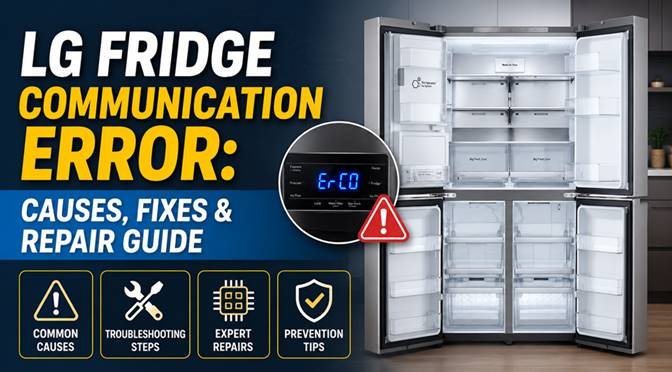
If your LG fridge is showing a Communication Error, a CO code or an Er CO code, it almost always means the display panel and the refrigerator's main control board have stopped communicating correctly. Depending on the model, the cause may be a damaged wiring harness inside the door hinge, a faulty display PCB, a failed main control board, a loose or corroded connector, or an intermittent break in the low voltage communication circuit.
Here is the part that surprises most people: the fridge usually keeps cooling. The compressor and fan circuits are controlled separately from the user interface, so food stays cold while the touch panel, ice maker, water dispenser and temperature controls stop responding.
Fast Fridge Repairs services LG refrigerators across Sydney, 24 hours a day. Call 0405 972 558 or book an LG fridge repair online.
What Does an LG Communication Error Mean?
A modern LG refrigerator is not a single circuit. It is a network of electronic boards that talk to each other continuously over a low voltage communication circuit.
The main boards involved are:
- Main PCB (main control board): the master board, usually mounted at the rear of the cabinet or in the base compartment. It controls the compressor, fans, defrost cycle and reads the thermistors.
- Display PCB / User Interface (UI): mounted in or on the door. It shows temperatures, error codes and dispenser status, and sends your button presses back to the main PCB.
- Door PCB or sub-board: used on some Door-in-Door, InstaView and dispenser models to manage door-mounted functions.
- Sensors and thermistors: feed temperature data back to the main PCB.
These boards exchange data packets constantly. When the main PCB sends a request and receives no valid reply within its expected time window, it logs a communication failure and the display shows CO, Er CO or a worded communication error, depending on the model and firmware.
At that point:
- The display flashes or shows the error code
- Touch buttons stop responding or respond inconsistently
- Ice and water dispensing stops
- Temperature settings cannot be changed
- Smart features and app control may drop out
Cooling usually continues because compressor and fan control sits on the main PCB itself. The main board already knows the last commanded set point and keeps running the sealed system to that target, even though it can no longer talk to the panel.
Symptoms of an LG Communication Error
| Symptom | Likely Cause | Next Step |
|---|---|---|
| CO or Er CO on display, fridge still cold | Communication link between main PCB and display PCB lost | Power reset, then book diagnosis if it returns |
| Error appears and clears when the door is opened or closed | Broken conductor or fatigued wire inside the door hinge harness | Harness continuity testing by a technician |
| Display works, buttons do nothing | Display PCB fault or ribbon cable / connector fault | Technician testing of display board and connectors |
| Display completely dead, fridge cooling normally | Loss of supply voltage to display board, or failed display PCB | Voltage testing at the display connector |
| Ice maker and water dispenser both stopped together | Door-mounted circuit or door harness fault | Harness and door PCB testing |
| Error returns after every reset | Hardware fault, not a software glitch | Professional diagnosis |
| Error present and cooling now inconsistent | Wider control fault involving the main PCB or sensors | Stop guessing, book a technician promptly |
Intermittent behaviour is the most common pattern. The fault appears, a reset clears it, and it returns days or weeks later. Intermittent faults are still hardware faults. They generally get worse, not better.
What Causes an LG Communication Error?
Different failures produce the same error code. The list below covers the realistic causes our technicians find in the field, roughly in order of how often we see them on door-interface models.
1. Damaged Door Wiring Harness
2. Loose or Unseated Wiring Connectors
3. Corroded Connector Pins and Moisture Damage
4. Faulty Display PCB
5. Failed Main PCB
6. Software or Firmware Glitch
Can You Fix an LG Communication Error Yourself?
You can safely perform a small number of checks. You should not attempt component level repair.
Safe for a homeowner:
- Performing a full power reset at the wall
- Looking at the exposed section of the hinge harness for pinched, kinked, chafed or split insulation
- Checking that the door closes freely and nothing is trapping the loom
- Checking the fridge and freezer temperatures with an independent thermometer
- Photographing the error code and recording when it appears and clears
Not safe and not appropriate:
- Removing the rear service panel or base cover
- Unplugging or reseating connectors on the main PCB
- Removing the door or the door skin
- Testing boards with a multimeter without training
- Bridging, joining or taping wiring
Step by Step Troubleshooting
- Unplug the fridge at the wall for 10 minutes. Do not simply switch it off and on. A full power down lets the boards fully discharge and restart their communication handshake.
- Plug it back in and watch the start up sequence. Note whether the display initialises normally, partially, or not at all.
- Observe the display for several minutes. Note whether the error returns immediately or after a delay.
- Open and close the door slowly, several times. Watch the panel while you do it.
- Note whether the error changes with door position. If it appears or clears as the door moves, the door harness is the prime suspect.
- Inspect the visible hinge harness. Look at the exposed loom at the top hinge for crushing, splitting or exposed copper. Look, do not pull.
- Record the exact error code and the model number. The model and serial plate is usually inside the fridge compartment on the side wall. Photograph both.
- Book a technician if the error returns. One clean reset that never comes back is fine. A returning error is a hardware fault.
How Fast Fridge Repairs Diagnoses This Fault
Our technicians work through the communication circuit in a fixed order so that the fault is proven, not guessed. Replacing a control board on a hunch is how people end up paying twice.
- Supply and power testing: Confirm the appliance is receiving correct supply voltage and that the main PCB is producing its expected low voltage rails.
- Error code interrogation: Read the displayed code and, where the model supports it, enter the service test mode to check what the main board is reporting.
- Communication circuit voltage check: Measure the signal and supply lines at the display connector to establish whether the display board is being fed correctly.
- Harness continuity testing: Test every conductor between the main PCB connector and the door interface, pin to pin, for continuity and for shorts to adjacent pins.
- Flex testing at the hinge: Continuity is monitored while the harness section is articulated, which is the only reliable way to catch an intermittent fracture.
- Connector and terminal inspection: Check pin seating, oxidation, heat damage and locking tab integrity at both ends.
- Display PCB assessment: Once supply and wiring are proven good, the display board is assessed as the non responding device.
- Main PCB assessment: If the display and harness are sound, the main board's communication section is assessed, along with the inverter board on inverter driven models where relevant.
- Component isolation: The faulty item is confirmed individually rather than by replacing parts in sequence.
- Repair and final testing: After the repair, the appliance is run through a full cycle, dispenser and ice maker functions are verified, temperatures are checked at both compartments, and the error log is confirmed clear.
Every repair carries a 12 month warranty on parts and labour, and we quote before any work begins.
Which LG Models Commonly Experience Communication Errors?
Communication errors can appear on any LG refrigerator with a separate display or user interface board. In practice, they are reported most often on models where the interface, dispenser or camera sits in the door, because those models require wiring to cross the hinge.
Model families where we most often attend this fault include:
- LG French Door and multi door refrigerators
- LG InstaView models, including the knock twice illuminated panel units many people call "knock knock" fridges
- LG Door-in-Door models
- LG side-by-side refrigerators with ice and water dispensers
- LG bottom mount models with a door mounted display
Different model families use different PCB layouts, connector types and communication protocols. A repair approach that suits one model can be completely wrong for another, which is why diagnosis always comes before any parts decision. You can see the full range of models we service on our LG fridge repairs Sydney page.
Does the Refrigerator Need a New Door?
Sometimes yes, but only after diagnosis, and it is not the most common outcome.
A door assembly replacement becomes necessary when the broken conductors sit inside a section of the door that cannot be opened up. On many modern refrigerators the door is a sealed unit with insulation foamed in around the wiring during manufacture. If the fracture is inside that foamed section, there is no way to access the individual wire, splice it safely, or restore the original insulation and vapour barrier. Replacing the door assembly is then the only durable repair.
Before accepting a door replacement quote, the technician should have confirmed all of the following:
- The main PCB is producing correct supply and signal voltages
- The display PCB is genuinely not responding, or is responding and the fault lies elsewhere
- Every conductor in the accessible harness has been continuity tested, including under flex
- All connectors are properly seated, clean and undamaged
- The fault has been traced specifically to wiring inside the non serviceable section
If those checks have not been done, a door replacement is a guess. Door assemblies are one of the most expensive parts on a refrigerator, so it is worth confirming the diagnosis before committing.
Does Cooling Continue During a Communication Error?
Usually, yes. The compressor, condenser fan, evaporator fan and defrost cycle are all driven by the main control board, and that board keeps operating to the last set point it held. Your food generally stays at a safe temperature while the display is showing the error.
There are exceptions. If the fault is on the main PCB rather than the door harness, or if it progresses, cooling can become unstable. Signs to watch for include temperatures drifting warmer, the compressor running constantly, frost building up in unusual places, or the freezer softening. Any of those changes turns a display fault into an urgent repair.
Is It Safe to Keep Using the Fridge?
In the short term, usually yes, provided you monitor it.
- Put an independent thermometer in the fridge compartment and check it twice a day. Aim for 3°C to 5°C in the fridge and around minus 18°C in the freezer.
- Accept that you cannot change the set temperature while the interface is down.
- Turn off the water supply at the isolation tap if the dispenser is behaving unpredictably.
- Do not keep resetting the fridge for weeks as a workaround. Repeated resets mask a fault that is progressing.
If temperatures start drifting, treat it as urgent. Our 24 hour emergency fridge repair service covers Sydney seven days a week.
Australian Consumer Law Considerations
Australian Consumer Law provides consumer guarantees that apply in addition to any manufacturer's warranty. Among other things, goods must be of acceptable quality, which includes being durable for a reasonable period.
What counts as a reasonable period is not a fixed number of years. It depends on factors such as the price paid, the nature of the goods, how they have been used and maintained, any statements made about the product, and the type of fault that has occurred. A premium refrigerator is generally expected to last longer than an entry level one.
Two points worth understanding:
- A manufacturer is not automatically required to repair or replace every appliance that develops a fault outside the warranty period. The consumer guarantee position depends on the circumstances of the individual case.
- Equally, the expiry of a manufacturer's warranty does not automatically end your rights under the consumer guarantees.
This article is general information, not legal advice. If you believe a fault has occurred earlier than reasonably expected, you can raise it with the retailer or manufacturer, and you can seek independent guidance. Keeping your proof of purchase, the model and serial number, a photograph of the error code and a written technician report will help you make your case, whichever way you decide to proceed.
How to Prevent Future Wiring Damage
Door harness fatigue is mechanical, so the way the door is used matters.
- Close the door with a controlled push rather than a swing or a slam.
- Avoid overloading door bins. Extra weight increases hinge stress and changes how the door hangs.
- Never pull or lean on the dispenser recess or the door handle to move the appliance.
- When moving the fridge, lift or walk it rather than dragging it by the doors.
- Check the exposed hinge loom once a year for chafing or crushing, particularly on fridges built into cabinetry.
- Keep the door seals in good condition. A poor seal causes condensation, and condensation is what corrodes connector pins. Our guide to fridge door seal problems explains what to look for.
- Address intermittent errors early. A wire with two broken strands is a far cheaper repair than a wire with twenty.
When Should You Call a Technician?
Book a licensed refrigeration technician if any of the following apply:
- The error persists after a 10 minute power down
- The error clears on reset but keeps coming back
- Touch buttons no longer respond
- The ice maker has stopped producing ice
- The water dispenser has stopped working
- The display is dead or partially lit
- Fridge or freezer temperatures have started changing
- You can see damaged, crushed or exposed wiring at the hinge
- There is any sign of water reaching electrical components
If cooling has been affected, treat it as urgent rather than routine.
Need LG Fridge Repairs in Sydney?
Fast Fridge Repairs has been repairing refrigerators across Sydney for over 20 years. Our licensed refrigeration technicians diagnose communication faults properly before any part is ordered.
Call 0405 972 558We repair LG refrigerators in homes across Sydney through our residential fridge repair service, and we also handle commercial refrigeration repairs for Sydney cafes, restaurants, clinics and offices.
Frequently Asked Questions
What does CO mean on an LG fridge?
CO, shown on some models as Er CO, indicates a communication error. The main control board has lost reliable data communication with the display or user interface board. It points to a wiring, connector or control board fault rather than a cooling system fault.
Why does my LG fridge communication error come and go?
Intermittent errors usually indicate a partially broken conductor inside the door hinge harness or a connector that is not making consistent contact. The circuit completes at some door positions and opens at others. The error is still a genuine hardware fault, and it typically becomes permanent over time.
Can a damaged door wire cause an LG communication error?
Yes. Wiring that passes through the door hinge flexes every time the door is opened, and individual copper strands can fracture inside insulation that still looks undamaged. It is one of the most common causes on French Door, InstaView and dispenser models, though it is not the only cause.
Does a communication error stop cooling?
Usually not. Compressor and fan control is handled by the main board independently of the display, so the fridge generally keeps cooling to its last set point. If the fault involves the main control board itself, cooling can become unstable, so temperatures should be monitored with a thermometer until the fault is repaired.
Does the whole fridge door need replacing?
Sometimes, but only after proper diagnosis. If the broken wiring sits inside a sealed, foam filled section of the door, individual conductors cannot be accessed and a door assembly replacement may be the only lasting repair. Before that is quoted, the technician should have cleared the main PCB, the display PCB, all connectors and the accessible harness.
Can I reset the error myself?
Yes. Unplug the refrigerator at the wall for 10 minutes, then restore power and watch the start up sequence. If the error was caused by a transient glitch, it will clear and stay clear. If it returns, the cause is a hardware fault and further resets will not help.
Is this covered under warranty?
If your LG refrigerator is still within its manufacturer's warranty period, contact LG or your retailer first, as unauthorised work may affect your cover. Outside the warranty period, Australian Consumer Law consumer guarantees may still apply, depending on the age of the appliance, its price, how it has been used and the nature of the fault. That assessment is case by case, and the ACCC or NSW Fair Trading can provide independent guidance.
Can Fast Fridge Repairs diagnose LG communication errors?
Yes. Our technicians test the full communication circuit, including supply voltages, harness continuity under flex, connector condition, the display PCB and the main control board, so the faulty component is identified before anything is replaced. Call 0405 972 558 for same day service across Sydney.