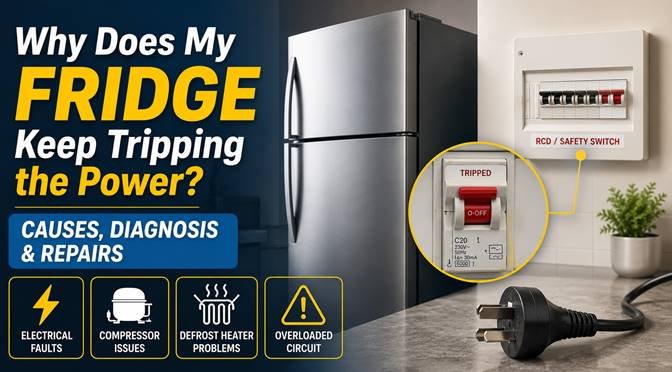
If your fridge keeps tripping the power, it is almost always an electrical fault rather than a cooling problem. Depending on whether a circuit breaker or an RCD (safety switch) is tripping, the cause may be a failing defrost heater, damaged compressor windings, faulty start components, moisture inside the cabinet, damaged wiring, a failed control board, or simply an overloaded household circuit.
The distinction matters more than most people realise. A circuit breaker trips because too much current is flowing through the circuit. A safety switch trips because current is escaping to earth — which means it is finding a path it was never meant to take. That second scenario is the one that can electrocute someone, and it is the reason a tripping fridge should never be treated as a nuisance to be reset and forgotten.
This guide explains what is actually happening inside the appliance, how the timing of the trip narrows down the fault, how a refrigeration technician diagnoses it properly, and when the fridge should be unplugged and left alone.
Key takeaway: If the safety switch (RCD) is the device tripping, unplug the fridge and leave it unplugged until it has been tested. Earth leakage means the metal parts of the appliance may become live.
Is It the Circuit Breaker or the Safety Switch?
A circuit breaker protects the wiring from too much current. A safety switch (RCD) protects people from electric shock by detecting current leaking to earth. Identifying which one tripped tells you whether you are chasing an overload or an insulation failure, and those are completely different faults.
Go to your switchboard and look at what actually moved before you touch anything else.
| Device Type |
Primary Function |
Common Reasons for Tripping |
| Circuit Breaker (MCB) |
Protects wiring from overcurrent & short circuits |
Short circuits, locked rotor compressor, seized fan motor, shorted capacitor, circuit overload |
| Safety Switch (RCD) |
Protects people from electric shock (earth leakage) |
Insulation failure in heaters/compressors, moisture on live parts, damaged wiring harness |
Circuit Breaker (MCB)
A miniature circuit breaker sits in series with the circuit and contains two independent trip mechanisms:
- A bimetallic strip: heats and bends under sustained overcurrent. This handles gradual overloads and takes seconds to minutes to operate.
- A magnetic solenoid: reacts almost instantly to a short circuit — a dead short between active and neutral, or active and earth.
A fridge will trip a circuit breaker when it draws more current than the circuit is rated for, or when something inside it shorts out. Typical causes include:
- A dead short in the power cord, plug, wiring harness or PCB
- A locked rotor compressor drawing locked rotor amps (commonly five to eight times normal running current) because it cannot start
- A seized evaporator or condenser fan motor with a stalled, overheating winding
- A shorted start or run capacitor
- Genuine circuit overload — too many appliances on one final subcircuit
Safety Switch (RCD)
A residual current device continuously compares the current flowing out on the active with the current returning on the neutral. In a healthy appliance those two are equal. If some current is leaking away through the earth conductor, through a damp insulation path, or through a person, the two no longer balance. Domestic socket outlet RCDs in Australia are typically rated at 30 mA and will operate at that imbalance within a fraction of a second.
An RCD trip on a fridge points to:
- Earth leakage: current escaping from a live conductor to the appliance chassis or earth wire
- Insulation failure: breakdown of the insulating material inside a heater, motor winding or compressor
- Moisture bridging: liquid water or condensation bridging live parts to earthed metal
- Cumulative leakage: where several appliances each leak a small, legal amount and the total on one RCD exceeds the trip threshold
Many modern switchboards use an RCBO, which combines both functions in one device. If your switchboard has RCBOs, look for a small test button on the device that tripped — that indicates residual current protection is built in, and you will usually need an electrician or refrigeration technician to confirm which mechanism operated.
Common Causes of a Fridge Tripping the Power
1. Faulty Defrost Heater
What it does: Frost-free refrigerators build ice on the evaporator coil as they remove moisture from the cabinet air. A defrost heater — usually a sheathed metal element or a glass-encased element mounted directly against or beneath the evaporator — periodically warms the coil to melt the frost, which drains away through the drain line. A defrost thermostat or sensor terminates the cycle once the coil reaches a set temperature.
Why it fails: Sheathed heaters use a compacted mineral insulation, typically magnesium oxide, between the resistance wire and the outer metal sheath. That material is hygroscopic — it absorbs moisture. If the sheath develops a pinhole, a crack, or corrosion at the end seals, moisture migrates into the insulation. The heater may still test as electrically continuous and still produce heat, but the insulation resistance between the element and the sheath collapses. Because the sheath is earthed, current leaks to earth every time the heater is energised. Glass-tube heaters fail differently: the glass cracks from thermal shock or ice contact, allowing water to reach the element directly.
Symptoms: The fridge cools normally and runs for hours, then trips the safety switch without warning. The trips repeat at roughly consistent intervals (e.g., every 6 to 12 hours). In earlier stages, the heater may only trip the RCD once it has been running for a minute or two and has warmed up.
How it is diagnosed: Insulation resistance testing (megger testing) between the heater terminals and earth, performed both cold and after the element has been warmed. A leakage clamp meter placed around the appliance flex during a forced defrost cycle will show leakage current climbing in real time. Continuity testing alone is not sufficient — a leaking heater usually has perfectly normal continuity.
How it is repaired: The heater is replaced with the correct part for the model. The evaporator cover is removed, the coil is fully defrosted, and the terminals, wiring and drain path are inspected at the same time.
If ignored: The RCD will keep tripping, stopping the compressor. Over time, ice builds on the evaporator because defrosts never complete, so the fridge eventually stops cooling altogether.
DIY appropriate? Visual inspection with the appliance unplugged is reasonable. Electrical testing and replacement is not — the heater sits in a confined space among easily punctured refrigerant tubing.
2. Failed Compressor Start Capacitor
What it does: Many larger domestic, commercial and older units use a capacitor. A start capacitor provides a phase-shifted current to the compressor's start winding, creating the rotating magnetic field needed to break the motor away from standstill against system pressure. A run capacitor, where fitted, stays in circuit to improve running efficiency.
Why it fails: Start capacitors are electrolytic and designed for intermittent duty only. Heat, frequent short-cycling, and age dry out the electrolyte. Capacitance drifts down, or the dielectric breaks down and the capacitor develops an internal short.
Symptoms: A shorted capacitor causes a large current surge on start and trips the circuit breaker instantly. A weakened capacitor causes the compressor to hum, fail to start, draw locked rotor current for several seconds, and then cut out on its overload protector. A bulged or leaking capacitor case is visible evidence.
How it is diagnosed: The capacitor is discharged safely, disconnected, and measured with a capacitance meter against its printed rating and tolerance.
How it is repaired: Replacement with a capacitor of the exact correct capacitance and voltage rating. Substituting an approximate value changes the phase angle and stresses the start winding.
If ignored: Repeated locked rotor starts overheat the start winding, turning a cheap capacitor repair into an expensive compressor replacement.
DIY appropriate? No. Capacitors store a dangerous electrical charge after the appliance is unplugged and must be discharged correctly.
3. Faulty Compressor
What it does: The compressor is the pump at the centre of the refrigeration system. It draws low-pressure refrigerant vapour from the evaporator, compresses it, and discharges it as high-pressure gas to the condenser. It is a hermetic unit sealed inside a steel shell.
Symptoms: The compressor clicks on and off every few minutes (overload protector cycling), trips the RCD after running for 10-20 minutes, or trips the circuit breaker instantly upon attempting to start.
How it is diagnosed: Winding resistance is measured between common, start and run terminals. Insulation resistance is measured from each terminal to the steel shell. Running current is checked with a clamp meter. On inverter models, the variable-frequency inverter board is assessed separately.
How it is repaired: A grounded or seized compressor cannot be repaired internally; it must be replaced. This involves recovering refrigerant, brazing in a new compressor and filter drier, evacuating the system, and recharging to exact factory specifications.
If ignored: Continuing to reset the breaker on a grounded compressor energises the appliance chassis path repeatedly, creating a severe electric shock risk.
DIY appropriate? No. Requires licensed refrigeration and electrical handling.
4. Faulty Start Relay
What it does: The start relay connects the compressor's start winding into circuit for the moment needed to get the motor turning, then disconnects it. Most modern domestic fridges use a PTC (Positive Temperature Coefficient) solid-state relay.
Why it fails: PTC devices degrade with thermal cycling and eventually crack internally or fail in a low-resistance state, leaving the start winding energised continuously. Electromagnetic relays fail by contact pitting or welding.
Symptoms: Repeated clicking noises every few minutes as the overload opens and closes. The compressor hums without starting. Excessive current draw. A PTC relay that rattles when removed and shaken is broken internally.
How it is diagnosed: Resistance of the PTC is measured when cold. The relay is inspected for cracked housing, heat discolouration, and burnt terminals.
How it is repaired: Replacement with the correct relay and overload assembly as a matched set.
If ignored: Every failed start attempt runs high locked rotor current through the compressor windings, risking total compressor failure.
DIY appropriate? No. Sits directly on live compressor terminals.
5. Damaged Power Cord or Plug
What it does: The flexible cord carries mains supply to the appliance and connects the chassis to the supply earth.
Why it fails: Cords get pinched behind the cabinet, crushed under castors/feet, chafed against sharp edges, or pulled at the plug entry. Heat from rear condensers can also embrittle insulation over time.
Symptoms: Immediate tripping when plugged in, tripping when the appliance is moved or vibrates, visible flattening or cuts in the sheath, discoloured plug pins, or a hot plug top.
How it is diagnosed: Visual inspection along the full cord length, insulation resistance testing while flexing the cord, and earth continuity testing from plug earth pin to chassis.
How it is repaired: The cord is replaced as a complete assembly. Taped repairs or joiners on a supply flex are unsafe and non-compliant.
If ignored: Risk of exposed live wires, arcing fires, or loss of protective earthing.
DIY appropriate? Visual inspection unplugged is fine; cord replacement requires electrical work.
6. Defective Main Control Board (PCB)
What it does: The main control board manages compressor cycles, fan speeds, defrost scheduling, temperature sensing, and damper control.
Why it fails: Relay contacts carry heavy inductive loads and eventually pit, weld, or arc. Moisture/condensation can reach base-mounted boards. Boards also contain EMI filter capacitors connected between mains and earth; as these degrade, earth leakage rises.
Symptoms: Intermittent trips with no repeatable pattern. Fans or compressor running unexpectedly. Burnt-electronics smell or visible scorching around PCB relays.
How it is diagnosed: Visual inspection for burnt tracks and bulged capacitors. Supply and output voltage checks. Leakage current measurement with downstream loads isolated. Note: Control boards must be disconnected before applying 500V DC megger testing, or the board will be destroyed.
How it is repaired: Control board replacement with the exact matching part number and firmware configuration.
If ignored: Can leave defrost heaters stuck on or compressors running continuously, secondary faults that destroy other components.
DIY appropriate? No.
7. Moisture or Water Damage
What it does & where it comes from: Meltwater from defrost cycles runs into a drain hole, down a line, and into an evaporation tray above the compressor.
Why it causes trips: When the drain line blocks with ice or food debris, meltwater backs up into the evaporator compartment. It pools around defrost heater terminals, thermostats, fan motors, and connectors. Water plus dissolved minerals is conductive; it bridges live terminals to earthed metal, tripping the RCD immediately.
Symptoms: Water pooling under crisper drawers, ice building on the freezer back wall, water on the floor, and trips coinciding exactly with defrost cycles.
How it is diagnosed: Evaporator cover removal, inspecting for pooled ice/water, testing individual component insulation resistance while isolated.
How it is repaired: Compartment is defrosted and dried, drain blockage cleared, corroded connectors replaced, and affected components re-tested.
If ignored: Corrosion spreads along wiring harnesses, turning a simple drain unclog into a major harness overhaul.
DIY appropriate? Clearing a visible drain hole unplugged is fine. Handling wet electrical connectors is not.
8. Damaged Internal Wiring
What it does: Harnesses distribute power and control signals to fans, lights, sensors, and displays across hinges and panels.
Why it fails: Door harnesses flex every time the door opens. Over thousands of cycles, conductors work-harden and fracture inside insulation, or chafe against metal hinges. Compressor compartment wiring can also vibrate against sharp cabinet edges.
Symptoms: Power trips that occur specifically when a door is opened or closed, or intermittent trips when the compressor vibrates during shutdown.
How it is diagnosed: Continuity testing while flexing the harness through its full range of movement, visual inspection at chafe points, and conductor-to-earth leakage testing.
How it is repaired: Replacement of the damaged harness section or fitting a complete manufacturer replacement door harness with correct strain relief.
If ignored: Can cause intermittent dead shorts or live cabinet conditions.
DIY appropriate? No.
9. Faulty Fan Motors
What they do: The evaporator fan circulates cold air inside the cabinet; the condenser fan cools the compressor and condenser coil underneath/behind the unit.
Why they fail: Winding insulation breakdown, bearing failure leading to a stalled rotor, or mechanical jamming caused by ice build-up (evaporator fan) or pet hair/lint accumulation (condenser fan).
Symptoms: A stalled fan motor overheats and draws high current, or its insulation breaks down to earth, tripping the RCD/MCB. A dead condenser fan causes extreme compressor overheating.
How they are diagnosed: Winding resistance checks, insulation resistance to frame, current draw checks, and manual spin tests with power isolated.
How they are repaired: Fan motor replacement alongside thorough cleaning of the condenser coils.
If ignored: A stalled condenser fan will rapidly destroy the compressor through thermal overload.
DIY appropriate? Vacuuming dust off condenser coils unplugged is good DIY maintenance. Testing and replacing motors is not.
10. Overloaded Household Circuit
Answer first: Sometimes the fridge is completely healthy, but the circuit it sits on is overloaded.
Why it happens: A fridge draws modest running current, but its compressor inrush current at start-up can be 5 to 8 times higher for a fraction of a second. If high-draw appliances (kettles, air fryers, microwaves, dishwashers) share the exact same power circuit, the fridge's start attempt can push the total current over the circuit breaker's trip limit.
Cumulative Earth Leakage: Similarly, multiple healthy appliances on one RCD each leak a tiny, legal amount of current. Combined, they sit right near the 30 mA limit—meaning any minor spike trips the safety switch even if no single appliance is technically faulty.
How to identify: The trip only occurs when other high-wattage appliances are running simultaneously, or the fridge operates perfectly when tested on a separate dedicated circuit.
What to do: Consult a licensed electrician to evaluate circuit loading or install a dedicated circuit for the refrigerator.
Why Ignoring the Problem Can Make Repairs More Expensive
A tripping fridge is not a self-resolving issue. Repeatedly resetting your switchboard forces the appliance through severe electrical stress and can lead to major compound failures:
- Compressor Winding Destruction: Every trip stops the compressor while system pressures are unequalised. Resetting it immediately forces the motor to start against extreme head pressure, drawing maximum locked rotor current and overheating start windings.
- Catastrophic Earth Shorts: Minor insulation breakdown on a compressor or heater degrades rapidly with each power reset until the component dead-shorts.
- Expensive Food Loss: Intermittent trips overnight or while you are at work ruin entire fridge and freezer contents, often costing far more than the initial repair.
- Control Board Burnout: Voltage spikes and high current arcs associated with repeated trips damage delicate switch-mode power supplies on main PCBs.
- Severe Electrical Shock Risk: If an RCD is tripping due to earth leakage, metal cabinet panels or door handles may carry dangerous voltages whenever power is restored.
When Should You Call a Refrigeration Technician?
You should disconnect power and call for professional service immediately if you notice any of the following signs:
- The circuit breaker or safety switch trips more than once
- You smell burning plastic or rubber, or see scorching around the plug socket or rear cabinet
- The compressor makes a repeated clicking noise every few minutes without starting
- You feel a tingle, static buzz, or electrical shock when touching the cabinet or door handle
- The fridge trips instantly the moment it is plugged into the wall
- You notice visible wiring damage, flattened cords, or signs of pest/rodent damage
- Internal temperatures are rising and food is thawing alongside the power trips
Note: If the circuit breaker trips even when the fridge is completely unplugged from the wall outlet, the fault lies within your home's building wiring. In that case, contact a licensed electrician.
Need Professional Fridge Repairs in Sydney?
Fast Fridge Repairs provides expert, systematic fault diagnosis for tripping power issues across all domestic and commercial refrigeration brands.
Call 0405 972 558
We provide comprehensive repair services including:
- Expert Fridge Repairs in Sydney for domestic top mount, bottom mount, side-by-side, French door and built-in models
- Fast response Commercial Fridge Repairs in Sydney for restaurants, cafes, commercial kitchens, retail outlets, and medical facilities
- Commercial Chiller Repairs for display cases, glass door fridges, uprights, and underbench units
- Fully licensed refrigeration technicians utilizing specialized insulation resistance and leakage testing tools
- Same-day service options across Sydney with upfront transparent quoting
Frequently Asked Questions
Why does my fridge keep tripping the safety switch?
A safety switch (RCD) trips when current leaks to earth, indicating that insulation between a live conductor and earthed metal has broken down. On a refrigerator, the most common causes are a defrost heater with moisture inside its insulation, compressor windings breaking down to the steel shell, meltwater reaching electrical connectors after a drain blockage, or a damaged door wiring harness. Unplug the fridge immediately as earth leakage presents a shock hazard.
Can a faulty compressor trip the circuit breaker?
Yes. A compressor with seized internal bearings or mechanical failure cannot rotate and draws locked rotor current (5 to 8 times normal running current). If the overload protector fails to open, the circuit breaker trips to prevent wiring damage. A compressor can also trip the breaker if its motor windings have dead-shorted.
Can a defrost heater cause an RCD to trip?
Yes. This is one of the most common reasons for a fridge that runs fine for several hours and then suddenly trips the power. Sheathed defrost heaters use mineral insulation that absorbs moisture if the metal outer casing cracks or corrodes. When the control board initiates a defrost cycle and energises the heater, current leaks to earth through the moisture path, tripping the RCD instantly.
Is it safe to keep resetting the breaker?
No. Repeatedly resetting a breaker forces high current surges through damaged components, turning easily repairable relay or capacitor faults into total compressor failures. Furthermore, if an RCD is tripping, resetting it can re-energise the metal frame of the fridge, creating a severe electrical shock hazard for anyone touching the appliance.