


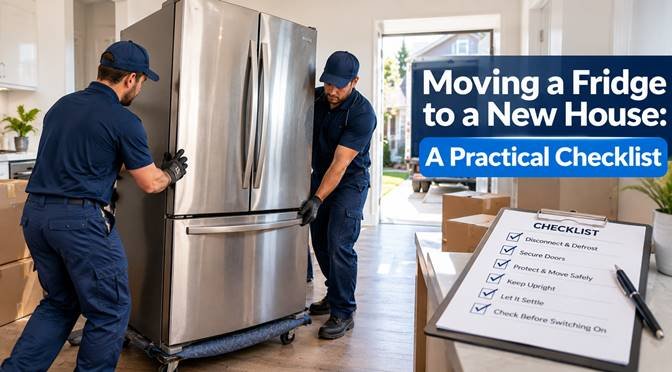
Moving a refrigerator takes more planning than moving a cupboard. Its weight, glass shelves, electrical connections and refrigeration components all need consideration.
The goal is to get it to the new property without damage, then return it to dependable operation before loading food.
Start with the transport instructions for your exact model. Keep the refrigerator upright during transport wherever specified, use suitable handling equipment and follow its restart requirements. There is no single standing time that applies to every fridge.
This guide covers preparation, moving day and the checks to make afterwards.
Before Moving Day: Check the Fridge and Both Properties
Locate the model number and download the correct manual if the original is missing. Look for sections covering transport, moving, disconnection and installation.
Then measure more than the kitchen recess.
| Check | Why it matters |
|---|---|
| Fridge width, height and depth | Establishes the space needed for the appliance |
| Handles and hinges | May extend beyond the main cabinet |
| Doorways and corridors | Confirms the route out and into the new property |
| Stairs, landings and lifts | Identifies difficult turns and handling requirements |
| New kitchen space | Must accommodate installation clearances as well as the cabinet |
| Door-opening space | Allows normal use and removal of internal drawers |
Tell your removalist about the refrigerator’s dimensions, weight and any difficult access. If doors or fitted panels may need removal, arrange the appropriate help rather than dismantling them without instructions.
1. Plan Where Your Food Will Go
Reduce the amount of refrigerated and frozen food you need to move by planning meals before moving day.
For food you are taking, arrange suitable alternative storage. That may include another operating refrigerator or insulated coolers with adequate cooling packs.
Ordinary cardboard moving boxes do not maintain refrigerated temperatures.
Consider the entire period without dependable cooling:
- Time spent emptying and preparing the old fridge.
- The journey.
- Any required standing time after transport.
- The time needed for the appliance to cool again.
Do not leave food inside the refrigerator as a substitute for proper transport storage.
2. Empty, Defrost and Dry the Appliance
Remove food, drinks and loose contents before moving.
If ice needs clearing, allow enough time for it to melt and for the interior to dry. The time required depends on the equipment and ice accumulation, so avoid treating “24 hours” as a rule for every model.
Follow the manual’s defrost instructions. Protect the surrounding floor and manage meltwater as it develops.
Do not:
- Chip ice with knives or screwdrivers.
- Force frozen drawers or lids.
- Use heat sources unless specifically permitted by the manufacturer.
- Allow water to reach electrical connections.
Once defrosting is complete, clean the interior using the recommended method and dry accessible surfaces.
If the fridge will remain out of service for an extended period, follow its storage instructions to limit trapped moisture and odours.
3. Disconnect Power and Any Water Supply Correctly
Switch off and unplug the refrigerator before moving it. Secure the lead so it cannot drag, catch or become trapped beneath the cabinet.
For a plumbed refrigerator, plan the water disconnection in advance. Know where the isolation valve is and whether the connection requires a qualified tradesperson.
Do not pull the appliance away from the wall while a hose or cable remains under tension.
At the new property, a different water connection or electrical arrangement may require additional work. Do not improvise connections simply to get the fridge operating.
4. Protect Shelves, Drawers and Doors
Glass shelves and loose fittings can move or break during transport.
Follow the manual’s instructions about which items to remove and which to secure. Wrap removed glass parts individually, protect their edges and label the package.
Keep small fittings together so they can be refitted correctly.
For the doors:
- Use an appropriate restraint to prevent unintended opening.
- Avoid excessive pressure on handles or panels.
- Check whether any tape is suitable for the surface.
- Do not secure doors by pulling against water lines or exposed components.
Built-in dispensers, wiring assemblies and fitted mechanisms should not be dismantled as routine packing preparation.
5. Protect the Cabinet and Floors
Use suitable padding to protect the refrigerator’s finish without pressing against vulnerable parts.
Do not use handles, pipework or hinges as lifting points unless the manufacturer expressly allows it.
Check the moving route for:
- Loose rugs.
- Uneven thresholds.
- Slippery surfaces.
- Narrow turns.
- Objects that could catch the trolley or cabinet.
Floor protection must suit the surface and handling equipment. Avoid dragging the fridge or relying on loose boards that may shift under its weight.
A refrigerator can be difficult to control once tilted. Arrange enough help and appropriate equipment before starting.
6. Use Suitable Moving Equipment
An appliance trolley must be appropriate for the refrigerator’s weight, dimensions and route. Its restraints should hold the cabinet securely without damaging it.
Stairs, steep access and truck loading require particular care. Use trained movers and suitable equipment where the route is difficult.
Avoid makeshift ramps or attempts to carry a heavy refrigerator without appropriate support.
Before loading, check that the refrigerator is stable on the handling equipment and that cords, hoses and protective coverings are secured.
Can You Transport a Fridge Lying Down?
Upright transport is the preferred arrangement for many refrigerators, but the exact model’s instructions must guide the move.
Do not assume that every fridge can safely travel on either side—or that a long waiting period afterwards will prevent every possible problem.
If upright transport is not possible:
- Check the model’s transport instructions.
- Ask the manufacturer for guidance if the instructions are unclear.
- Tell the removalist about any restrictions.
- Record how the appliance was transported.
Transport on its back can also expose vulnerable components to damage. Protecting the exterior does not make every transport position suitable.
7. Secure the Fridge Inside the Vehicle
The refrigerator should be restrained using suitable equipment and secure vehicle anchor points.
The arrangement must prevent movement or tipping without crushing the cabinet or placing stress on handles and components.
Do not rely on the fridge’s weight to keep it stationary.
Keep packed shelves and drawers protected separately, and ensure other items cannot fall against the appliance during the journey.
8. Inspect It Before Switching On
At the new home, check for visible damage before connecting power.
Look for:
- Cabinet dents that affect door movement.
- Cracked glass.
- Damaged hinges or handles.
- A cut, crushed or stretched power lead.
- Damaged water tubing.
- A door that no longer sits correctly.
- Unusual staining or damage around accessible components.
Photograph any damage and raise it with the responsible moving or delivery provider.
If you suspect damage to electrical or refrigeration components, do not switch the appliance on to test it.
How Long Should a Fridge Stand After Moving?
Follow the manufacturer’s instructions for the model and transport position.
Do not rely on a universal instruction to wait two, four, twelve or twenty-four hours. Requirements can differ.
If the refrigerator was laid down, heavily tilted or transported in an unknown position, ask for model-specific guidance before restarting it.
Remember that these are separate stages:
- Standing before switching on.
- Cooling after switching on.
- Confirming suitable storage temperatures before loading food.
Completing the first stage does not mean the fridge is immediately ready for groceries.
9. Check Its Position at the New Property
Before startup, confirm that the installation meets the model’s requirements.
Check:
- Ventilation clearances.
- Floor support and cabinet stability.
- The specified levelling adjustments.
- Door-opening space.
- Access to the power connection.
- Protection of any water tubing.
Do not assume that the new kitchen allows the same arrangement as the old one. Different cabinetry or a nearby heat source can affect operation.
10. Allow Cooling Before Reloading
Switch the refrigerator on according to its instructions and use the recommended initial settings.
Allow it to reach the required operating conditions before transferring perishable food. A cool-feeling shelf or a working light does not confirm readiness.
Use a suitable thermometer and follow the model’s startup guidance. Minimise door openings while it cools, then load without obstructing internal vents.
For a plumbed model, follow the specified reconnection, flushing and first-use instructions, and check accessible connections for leaks.
Fridge Problems After Moving: What Should You Check?
A change in operation may relate to positioning, connections, settings or damage. The timing alone does not establish the cause.
| What you notice | Information useful for assessment |
|---|---|
| Fridge not cooling | Transport position, standing time, startup time and settings |
| Freezer cold but fridge warm | Whether both sections worked normally before moving |
| New rattling or vibration | Cabinet stability and contact with nearby surfaces |
| Door not closing | Alignment, obstructions and visible hinge damage |
| Water underneath | Reconnection, defrosting, cleaning and where the water appears |
| Alarm or display error | Exact code and when it first appeared |
| Repeated power tripping | Stop using the appliance and arrange professional assessment |
Avoid repeated resets or dismantling panels to investigate.
Fast Fridge Repairs provides fridge repairs Sydney wide for refrigerators and freezers that develop cooling, drainage, control or mechanical faults.
When calling about a post-move problem, describe how the appliance was transported and what changed afterwards.
Fridge Struggling to Cool After Your Move?
If your refrigerator has finished its standing time but fails to cool, makes abnormal noises or triggers circuit breakers, speak directly with our certified technicians.
Moving-Day Fridge Checklist
Before the Move
- ✓ Find the exact model’s transport instructions.
- ✓ Measure access at both properties.
- ✓ Arrange appropriate movers and handling equipment.
- ✓ Plan alternative food storage.
- ✓ Empty, defrost where required, clean and dry.
- ✓ Arrange safe disconnection.
- ✓ Remove or secure parts according to the manual.
During Transport
- ✓ Follow the permitted transport position.
- ✓ Protect the cabinet and vulnerable components.
- ✓ Restrain doors appropriately.
- ✓ Secure the refrigerator against movement.
- ✓ Keep cords and hoses protected.
At the New Home
- ✓ Inspect for damage.
- ✓ Follow any required standing period.
- ✓ Confirm ventilation, stability and door clearance.
- ✓ Reconnect as instructed.
- ✓ Check for leaks.
- ✓ Allow cooling before loading food.
- ✓ Record any unusual symptoms.
Moving a Fridge FAQs
Yes. It still needs emptying, cleaning and inspection for ice or trapped water. Follow its moving instructions rather than assume frost-free equipment can be moved immediately without preparation.
Empty the cabinet before moving. Contents add weight and may shift, spill or damage the interior.
Check the manual. Rollers may be intended for limited movement in particular directions, rather than transport across every surface or around turns.
Only where the model permits it and the work is handled correctly. Doors may contain wiring or water connections. Plan this before moving day.
Not necessarily. However, do not assume it is safe to start immediately. Follow the model’s instructions and report the transport position if problems develop.
Different rooms and flooring can change how sound is heard. Check stability and contact with nearby surfaces. New grinding, persistent vibration or noise accompanied by poor cooling needs assessment.
This guide covers preparation and equipment care. For physical transport, arrange a suitable removal service. Contact Fast Fridge Repairs for diagnosis if the refrigerator develops an operating fault.
Need Assistance With a Refrigerator Fault After Moving?
This guide covers preparation and equipment care. For physical transport, arrange a suitable removal service. Contact Fast Fridge Repairs for prompt on-site diagnosis and repairs if your refrigerator develops an operating fault.