


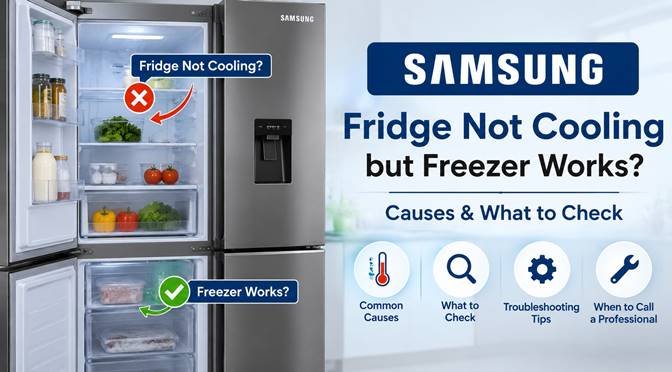
If your Samsung fridge is not cooling but the freezer still works, the refrigerator is usually still producing some cooling, but something is preventing the fresh-food compartment from reaching the correct temperature.
Depending on the Samsung model, the problem may involve restricted airflow, evaporator fan operation, frost or ice around the evaporator, defrost components, temperature sensors, electronic controls or the refrigeration system itself.
It is important not to assume that every Samsung fridge with this symptom has the same fault. Some models use airflow from a freezer evaporator, while others can have separate evaporators, fans or temperature-control arrangements.
If basic checks do not restore normal cooling, Samsung fridge repairs from Fast Fridge Repairs can diagnose the underlying refrigeration fault.
Why Can the Freezer Be Cold While the Samsung Fridge Is Warm?
A refrigerator has to do more than simply produce cold temperatures.
It also needs to:
- sense temperature correctly
- move cold air where it is required
- control frost on the evaporator
- operate fans correctly
- open or control airflow pathways where fitted
- cycle the compressor and refrigeration system appropriately
If the freezer remains cold but the refrigerator section becomes warm, the cooling system may still be operating while airflow or temperature control in the fresh-food section has been disrupted.
However, this varies between models.
Some Samsung refrigerators use a cooling arrangement where airflow between sections is particularly important. Others use multiple evaporators or separate cooling zones, so a fresh-food cooling problem may involve components dedicated specifically to the refrigerator compartment.
Key Insight: That is why model-specific diagnosis matters.
Common Causes of a Samsung Fridge Not Cooling While the Freezer Works
1 Frost or Ice Restricting Airflow
Excessive frost is one possible cause of poor cooling in the refrigerator section.
Ice can build up around an evaporator, fan housing or air pathway and reduce the amount of cold air reaching the fresh-food compartment.
Signs can include:
- freezer still cold
- refrigerator temperature gradually rising
- reduced airflow from internal vents
- fan noise or scraping
- frost visible around the rear internal panel
- cooling temporarily improving after the fridge has been switched off for an extended period
Visible ice is a clue, but it does not identify the cause by itself.
The reason for the frost may involve the defrost system, door sealing, drainage, temperature sensing or another control problem.
Simply removing the ice without finding out why it formed can allow the fault to return.
2 Evaporator Fan Problem
Evaporator fans move cold air through the refrigerator.
If a fan stops, slows down or becomes obstructed by ice, the freezer may remain cold while the fresh-food compartment receives insufficient airflow.
Possible warning signs include:
- little or no air coming from fridge vents
- unusual fan noise
- cooling changes when doors are opened or closed
- fridge warming while freezer temperature remains normal
- scraping caused by ice contacting a fan blade
A fan that turns freely by hand is not necessarily proven to be operating correctly under normal conditions.
Electrical supply, control signals, fan speed and intermittent operation can also matter.
Depending on the Samsung model, there may be more than one evaporator fan.
3 Defrost System Fault
Normal frost forms on an evaporator during refrigeration operation.
Frost-free refrigerators are designed to remove this automatically through a defrost cycle.
Depending on the model, the defrost system can involve:
- a defrost heater
- temperature or defrost sensors
- thermal protection components
- electronic control logic
If the system does not defrost correctly, ice can gradually build up and restrict airflow.
The result can be a freezer that still feels cold while the refrigerator section gets progressively warmer.
This is one reason that repeatedly defrosting the refrigerator manually may provide only temporary relief.
4 Blocked Internal Air Vents
Sometimes the problem is simpler.
Food containers, large packages or items placed directly against internal vents can interfere with air movement.
Before assuming the fridge has a component failure, check that:
- internal vents are not covered
- food is not tightly packed against the rear wall
- cold-air outlets have space around them
- the fridge is not excessively overloaded
Rearranging food can improve circulation if blocked airflow is the only problem.
However, if airflow remains weak with clear vents, further diagnosis may be needed.
5 Door Not Sealing Properly
A refrigerator door that does not close or seal correctly can allow warm, humid air into the cabinet.
Possible causes include:
- dirty door gaskets
- damaged or split seals
- food preventing the door from closing
- misaligned doors
- worn hinges
- ice interfering with closure
Warm air entering the refrigerator can increase condensation and frost formation and make it more difficult for the fridge compartment to maintain temperature.
Clean the gasket with mild soapy water and inspect it for obvious damage.
A torn or badly deformed gasket may need replacement.
6 Temperature Sensor or Thermistor Fault
Modern Samsung refrigerators use temperature sensors to help the control system decide when cooling is required.
If a sensor gives an incorrect reading, the electronic controller may not operate the refrigerator section as expected.
Possible symptoms can include:
- fridge warmer than the selected setting
- intermittent cooling
- food freezing in some situations
- unusual cycling
- temperature warnings
- error codes on some models
Sensor resistance and temperature behaviour may need to be tested to determine whether the sensor itself is faulty.
7 Air Damper or Airflow Control Problem
Some refrigerator designs use a damper or other airflow-control mechanism to regulate the movement of cold air between compartments.
If the mechanism is:
- stuck
- obstructed by ice
- mechanically damaged
- not receiving the correct control signal
the freezer can remain cold while the fridge section becomes warm.
However, not every Samsung refrigerator uses the same damper arrangement.
Some Samsung models use separate evaporators or different cooling architecture, so it is important not to assume that every freezer-cold/fridge-warm fault is caused by a damper.
8 Separate Fresh-Food Evaporator or Cooling Circuit Problem
Some Samsung refrigerator models use more than one evaporator or separate cooling arrangements for individual compartments.
In these designs, the freezer may operate correctly while the refrigerator-side evaporator, fan, sensor or refrigerant control develops a problem.
This is particularly important because generic advice such as “the freezer sends cold air into the fridge” does not apply equally to every Samsung refrigerator.
Model information can therefore make a major difference during diagnosis.
9 Electronic Control Board Problem
The electronic control system can influence:
- fan operation
- sensors
- defrost cycles
- compressor commands
- airflow controls
- valves on some systems
A control-board fault is possible, but it should generally not be the first component replaced simply because the refrigerator is warm.
The relevant sensors, fans, wiring, airflow and refrigeration performance should normally be checked first.
10 Refrigeration or Sealed-System Fault
A cold freezer does not completely rule out a refrigeration-system problem.
On some designs, weak refrigeration performance or a problem affecting one part of a multi-evaporator system can cause one compartment to perform differently from another.
Possible sealed-system areas can include:
- compressor performance
- refrigerant charge
- refrigerant flow
- valves on applicable models
- evaporator performance
Critical Sealed-System Rule: Low refrigerant should not simply be treated by adding gas. Refrigerant operates within a sealed system, so if charge is low, the reason needs to be investigated.
What Can You Safely Check Yourself?
Before arranging a repair, there are several simple checks that do not require dismantling the refrigerator.
Check the Temperature Settings
Make sure the fridge has not accidentally been set too warm.
Also check whether any special operating mode has been activated.
Allow enough time after changing settings for the cabinet temperature to respond.
Make Sure the Fridge Is Not Overpacked
Move food away from internal air vents and leave enough space for air to circulate.
A tightly packed cabinet can reduce airflow even when the refrigeration system itself is operating.
Check the Door Seal
Inspect the refrigerator gasket for:
- food debris
- splits
- obvious gaps
- sections pulling away from the door
Clean dirty seals gently and make sure nothing inside the refrigerator is preventing the door from closing.
Check for Visible Frost
Look at the rear internal panel of the refrigerator and freezer.
A heavy frost pattern or protruding ice may indicate an airflow or defrost problem.
Avoid removing internal panels or using sharp tools to chip ice away.
Listen for Fan Noise
If the refrigerator normally makes an airflow sound but has suddenly become quiet, fan operation may be relevant.
Likewise, scraping or repetitive fan noise can sometimes occur when ice contacts a fan blade.
Check for Error Codes
If an error code appears, record it before switching the appliance off.
Our Samsung fridge error codes guide explains common Samsung refrigerator codes and what they may indicate.
Should You Defrost a Samsung Fridge That Is Not Cooling?
If heavy ice is restricting airflow, switching the refrigerator off for a sufficient period may allow the ice to melt and temporarily restore airflow.
However, that should not be confused with repairing the underlying problem.
If the refrigerator begins cooling normally after defrosting but the same fault returns later, there may be a problem involving:
- defrost components
- temperature sensing
- fan operation
- door sealing
- drainage
- electronic controls
Repeated frost should be investigated.
Safety Precaution: Avoid using knives, screwdrivers or other sharp objects to remove ice because evaporator tubing and internal components can be damaged. It is also safer to avoid directing high heat onto plastic panels, wiring or refrigeration components.
How Do You Reset a Samsung Refrigerator That Is Not Cooling?
A reset can sometimes clear a temporary control issue, but it does not repair failed fans, sensors, defrost components or refrigeration faults.
If Samsung's instructions for your specific model recommend a power reset, follow the manufacturer procedure.
Before resetting the appliance, write down any error code that is currently displayed.
If cooling improves briefly and then the same problem returns, the underlying fault still needs to be diagnosed.
How Do You Turn Cooling Back On a Samsung Fridge?
Some Samsung refrigerators have operating modes intended for display, demonstration or other specific functions.
If the refrigerator lights and display work but neither compartment is cooling, check whether the appliance is in a mode that disables normal cooling.
Because the procedure varies by model, refer to the Samsung instructions for your exact refrigerator rather than using a button sequence intended for another model.
If the freezer is already cooling normally but only the fridge section is warm, a cooling-disabled mode is less likely to explain the symptom.
How a Technician Diagnoses a Samsung Fridge When the Freezer Still Works
The diagnosis should follow the symptom rather than immediately replacing a commonly blamed part.
Depending on the model, a refrigeration technician may check:
Actual Cabinet Temperatures
Temperatures in both sections help establish how serious the imbalance is.
Frost Pattern
The condition of the evaporator can help show whether the problem is primarily airflow, defrost or refrigeration related.
Evaporator Fan Operation
The fan may need to be checked for:
- correct operation
- obstruction
- electrical supply
- control signal
- abnormal noise
Temperature Sensors
Thermistors or sensors can be tested to determine whether their readings are consistent with actual cabinet temperatures.
Defrost Components
Where excessive frost is present, the heater, sensors and related controls may require testing.
Airflow Controls
On applicable models, dampers or other airflow-control mechanisms may need inspection.
Electronic Controls
PCB outputs and component commands may need to be checked if other components appear functional.
Refrigeration-System Performance
Where airflow and controls appear normal, the sealed refrigeration system may require further assessment.
Why Model Number Matters With Samsung Refrigerators
Samsung refrigerator architecture varies considerably between models.
For example, one refrigerator may depend heavily on airflow between compartments, while another may use separate evaporators or additional controls.
That is why a repair method that worked on one Samsung fridge may not apply to another.
Before booking a repair, locate the refrigerator model number if practical.
It can help identify:
- fridge configuration
- cooling architecture
- component layout
- relevant technical information
- model-specific error codes
Also note whether the freezer still works and whether any ice, water leakage or unusual fan noise is present.
Is a Samsung Fridge Worth Repairing if the Freezer Still Works?
Often, yes, but the decision depends on what has actually failed.
A refrigerator may still be worth repairing if the problem involves:
- a fan
- sensor
- door seal
- drainage
- defrost component
- airflow-control component
- electronic control
Major compressor or sealed-system faults require a different assessment.
Factors to consider include:
- refrigerator age
- overall condition
- repair history
- parts availability
- repair cost
- cost of a comparable replacement
The fact that the freezer still works does not automatically mean the repair will be minor, but it can provide useful diagnostic information.
When Should You Call a Samsung Fridge Technician?
Arrange professional diagnosis if:
- the freezer is cold but the fridge remains above normal temperature
- airflow from the fridge vents has stopped
- heavy ice keeps returning
- the evaporator fan is noisy
- the appliance displays an error code
- water leakage keeps returning
- the refrigerator cools temporarily after defrosting and then becomes warm again
- basic airflow and door-seal checks do not solve the problem
Avoid repeatedly replacing sensors, fans or control boards based only on online suggestions.
Similar symptoms can have different causes depending on the Samsung model.
Samsung Fridge Repairs in Sydney
Fast Fridge Repairs provides independent Samsung refrigerator and freezer repairs throughout Sydney.
Our technicians can diagnose Samsung refrigeration faults involving:
- cooling
- airflow
- evaporator fans
- defrost systems
- sensors
- drainage
- electronic controls
- compressor operation
- sealed refrigeration systems
Fast Fridge Repairs has more than 20 years of refrigeration experience, is ARCtick licensed, and provides a 12-month parts warranty on parts supplied by us.
Notice of Independence: We are an independent refrigeration repair business and are not represented as an authorised Samsung service centre. If your refrigerator may still be covered by Samsung's manufacturer warranty, check your warranty options before arranging independent repairs.
Frequently Asked Questions
The refrigerator may still be producing cooling but not maintaining the fresh-food section correctly. Possible causes include restricted airflow, evaporator fan problems, excessive frost, defrost faults, sensors, airflow controls or model-specific refrigeration faults.
There is no single fault that applies to every Samsung refrigerator. Poor cooling can be associated with fan problems, frost build-up, defrost faults, temperature sensors, airflow restrictions, electronic controls or refrigeration-system problems.
A reset may clear a temporary control problem but will not repair a failed fan, sensor, defrost component or refrigeration-system fault. If the problem returns after resetting, diagnosis is recommended.
If cooling returns after the ice has melted and later deteriorates again, recurring frost may be restricting airflow. The underlying cause can involve defrost components, sensing, fans, door sealing, drainage or electronic controls.
Yes. Food or ice obstructing internal vents can reduce airflow into the refrigerator compartment. Make sure vents are clear before assuming there is a component failure.
Not necessarily. Airflow, fans, sensors, defrost components and controls can all cause poor cooling. Refrigerant is part of a sealed system and should not simply be added without diagnosing why refrigeration performance is low.
Not automatically. The repair may involve an individual fan, sensor, defrost component, control or airflow issue. Diagnosis is needed before deciding whether repair or replacement offers better value.
Samsung Fridge Still Not Cooling?
If your Samsung freezer is working but the refrigerator compartment remains warm, the temperature difference provides an important clue but does not identify the failed component by itself. Fast Fridge Repairs can diagnose the airflow, defrost, sensor, fan, control and refrigeration systems relevant to your Samsung model and explain the repair options.