


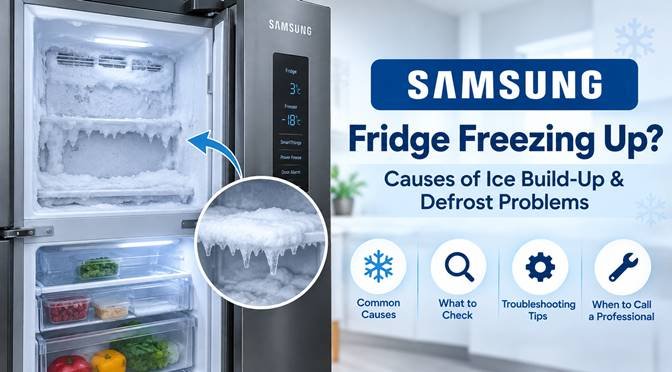
If your Samsung fridge keeps freezing up or developing heavy ice, the visible frost is usually a symptom rather than the complete fault.
Depending on the model and where the ice is forming, possible causes include a defrost-system problem, blocked drain, evaporator fan issue, temperature sensor fault, poor airflow or warm humid air entering through a door or ice-dispenser opening.
A small amount of frost can occur during normal refrigerator operation. The problem starts when ice continues building until it interferes with airflow, blocks drainage, contacts the evaporator fan or affects cooling in the refrigerator compartment.
If the same ice returns after the appliance has been defrosted, the underlying cause should be diagnosed rather than repeatedly melting the frost.
For professional diagnosis, Fast Fridge Repairs provides Samsung fridge repairs in Sydney for suitable refrigerators and freezers.
Why Does a Samsung Refrigerator Keep Icing Up?
Refrigerators remove heat by passing air around a cold evaporator.
Moisture in that air naturally forms frost on the evaporator surface. In a frost-free refrigerator, the appliance periodically manages that frost through its automatic defrost system.
Problems develop when:
- too much moisture enters the cabinet
- normal frost is not removed correctly
- defrost water cannot drain
- airflow becomes restricted
- a fan is obstructed
- temperature sensing becomes inaccurate
- a door or ice chute does not seal correctly
The location of the ice provides an important clue.
Ice behind an internal rear panel may indicate a different problem from a sheet of ice underneath the crisper drawers or frost around a freezer door.
Causes of Ice Build-Up & Defrost Problems
1 Defrost System Not Removing Frost Properly
A defrost fault is one possible cause when ice repeatedly builds around an evaporator.
Depending on the Samsung model, the defrost system can include:
- a defrost heater
- temperature or defrost sensors
- thermistors
- thermal protection components
- electronic control logic
If the evaporator is not being defrosted correctly, frost can gradually become thick enough to obstruct the air passages around it.
Possible symptoms include:
- fridge gradually getting warmer
- freezer remaining cold
- reduced airflow from refrigerator vents
- fan noise
- scraping from ice contacting a fan
- frost returning after a manual defrost
The correct repair depends on which part of the system is not operating correctly.
Replacing the heater simply because ice is present is not always the right diagnosis. Sensors, controls, wiring or other components can produce similar symptoms.
2 Blocked or Frozen Defrost Drain
During a normal defrost cycle, melted frost needs somewhere to go.
The water normally drains away through a drain opening and tube.
If that pathway becomes blocked by ice or debris, water may collect and freeze again.
Depending on the refrigerator design, you may notice:
- ice forming underneath drawers
- water underneath the crisper section
- water later freezing into a sheet
- recurring moisture inside the fridge
- ice around the drain area
A blocked drain is different from a failed cooling system.
However, repeated drain freezing can sometimes be related to another issue, so simply clearing visible ice may not prevent the problem from returning.
3 Evaporator Fan Becoming Restricted by Ice
The evaporator fan helps circulate cold air through the refrigerator.
If ice forms around the fan housing or fan blade, airflow can reduce dramatically.
Common signs include:
- clicking or scraping noises
- fan becoming louder
- airflow becoming weak
- fridge compartment becoming warm
- freezer continuing to feel cold
- noise disappearing after the refrigerator has been fully defrosted
In severe cases, the ice can physically stop the fan from turning.
If your Samsung fridge is warm while the freezer continues working, our guide to Samsung fridge not cooling but freezer works explains this symptom in more detail.
4 Door Seal Allowing Warm Air Inside
Warm air contains moisture.
If a refrigerator door does not seal correctly, warm humid air can continually enter the cabinet. When that moisture reaches cold internal surfaces, it can condense and freeze.
Check for:
- torn door gaskets
- sections of seal pulling away
- food packaging preventing the door from closing
- dirt or residue on the gasket
- misaligned doors
- damaged hinges
You can also inspect whether the seal is making reasonably even contact around the entire door.
A damaged gasket does not always cause dramatic frost immediately. Ice can build gradually as warm air repeatedly enters the refrigerator.
5 Ice Maker or Ice Chute Not Sealing Correctly
On Samsung models fitted with an external ice dispenser, the ice chute or flap can be another point where warm room air enters.
If the flap remains partly open because of ice, debris or a mechanical problem, humid air can enter the cold compartment.
That can contribute to frost formation around the ice-making area.
Possible signs include:
- frost around the ice bucket
- ice clumping together
- frost around the chute
- visible gap around the dispenser flap
This does not apply to every Samsung refrigerator, so diagnosis should take the exact model and ice-maker design into account.
6 Food Blocking Air Vents
Not every freezing or icing problem requires a component replacement.
Food pushed tightly against internal vents or the rear wall can interfere with normal airflow.
Check whether:
- packages are covering vents
- shelves are heavily packed
- food is pressed against the rear internal panel
- cold-air outlets have adequate clearance
Restricted airflow can produce uneven cabinet temperatures and encourage frost in certain areas.
Rearranging food is a simple first check before assuming the refrigerator has a mechanical fault.
7 Temperature Sensor or Thermistor Problem
Samsung refrigerators use temperature sensors to help the control system regulate cooling.
If a thermistor or sensor provides an inaccurate reading, the refrigerator may not control cooling or defrost operation correctly.
Depending on the model, symptoms can include:
- excessive cooling
- inconsistent temperatures
- recurring frost
- fridge too warm
- fridge freezing food
- unusual compressor or fan cycling
A sensor should be tested rather than replaced purely because the refrigerator is icing.
8 Electronic Control Problem
The control board can influence several refrigerator functions, including:
- fan operation
- temperature regulation
- compressor commands
- defrost cycles
- sensors
- valves or airflow controls on applicable models
An electronic control fault can contribute to icing, but it should not automatically be blamed whenever heavy frost appears.
A proper diagnosis should first establish what the sensors, fans and defrost components are actually doing.
9 Ice Forming Because the Fridge Is Too Warm
This may sound contradictory, but a refrigerator that is running warmer than intended can sometimes develop condensation that later freezes in colder areas.
Samsung's own troubleshooting guidance notes that inappropriate temperatures and humid air can contribute to condensation and frost.
If the refrigerator compartment is too warm:
- check the temperature setting
- make sure the doors close fully
- ensure vents are not obstructed
- avoid placing hot food directly into the fridge
- check whether the appliance is overloaded
If temperatures remain abnormal after these checks, the underlying cooling problem should be investigated.
Where Is the Ice Forming?
The location of the frost can help narrow down the likely cause.
Ice Behind the Rear Internal Panel
This can be associated with:
- evaporator frost
- defrost faults
- fan obstruction
- temperature sensing
- airflow problems
If the panel appears swollen or you can hear a fan contacting ice behind it, avoid forcing the panel off while it is frozen.
Ice Under the Crisper Drawers
A sheet of ice or recurring water underneath the drawers can point towards:
- blocked defrost drainage
- frozen drain opening
- condensation
- water migrating from another part of the cabinet
Frost Around the Freezer Door
This may indicate:
- door not fully closing
- damaged gasket
- food preventing closure
- misaligned door
- humid air entering the compartment
Ice Around the Ice Maker
Possible areas include:
- ice chute sealing
- ice bucket
- water supply
- ice-maker components
- temperature conditions around the ice compartment
The exact cause varies considerably between models.
Can You Safely Check Anything Yourself?
Yes. There are several non-invasive checks that can be done before arranging professional service.
Check the Door Is Closing Fully
Make sure bottles, drawers or food packages are not preventing the refrigerator or freezer door from closing.
Inspect the Door Gaskets
Look for:
- tears
- dirt
- loose sections
- obvious gaps
Clean the gasket gently with mild soapy water if required.
Clear the Air Vents
Move food away from vents and avoid packing groceries tightly against the back wall.
Check the Temperature Setting
Make sure the fridge or freezer has not accidentally been set excessively cold or warm.
Look for Visible Frost
Heavy frost or ice around an internal rear panel can help confirm that the problem involves more than a simple temperature setting.
Record Any Error Code
If your Samsung refrigerator displays a warning or error, record it before resetting or unplugging the appliance.
Our Samsung fridge error codes guide explains common codes and what they may indicate.
Should You Remove the Rear Panel Yourself?
Removing refrigerator panels can expose:
- electrical wiring
- sensors
- fan assemblies
- evaporator tubing
- heaters
- sharp metal components
If the panel is frozen in place, pulling it away can also damage wiring, insulation or internal parts.
For most homeowners, it is safer to leave internal component testing and panel removal to a refrigeration technician.
Can You Defrost a Samsung Refrigerator Yourself?
A complete power-off defrost can sometimes clear ice that is restricting airflow.
If you do this:
- unplug the refrigerator
- remove food that needs to remain chilled or frozen
- leave the doors open
- protect flooring from melting water
- allow enough time for hidden ice to melt naturally
Avoid using:
- knives
- screwdrivers
- metal objects
- sharp tools
Safety Warning: These can puncture evaporator tubing or damage internal surfaces. High heat should also be avoided around plastic, wiring and refrigeration components.
Most importantly, remember: Defrosting removes the ice. It does not necessarily repair the reason the ice formed. If the problem returns, further diagnosis is needed.
Why Does My Samsung Fridge Work After Defrosting and Then Freeze Again?
This is a particularly useful diagnostic pattern.
If:
- the refrigerator becomes warm,
- you find heavy ice,
- the fridge is completely defrosted,
- cooling returns,
- then the same problem happens again,
the recurring frost suggests that the underlying cause has not been corrected.
Possible areas include:
- defrost heater
- defrost sensor or thermistor
- drainage
- fan operation
- door sealing
- electronic controls
- model-specific component issues
A temporary improvement after defrosting does not confirm which component has failed.
What About Forced Defrost Mode?
Some Samsung refrigerator models have diagnostic or forced-defrost functions.
The procedure varies between models.
Do not use random button combinations from another Samsung refrigerator because control-panel layouts and diagnostic modes can differ.
Even when a forced defrost melts some frost, the reason for the recurring ice may still remain.
If the refrigerator continually requires forced defrosting, professional diagnosis is a better long-term solution than repeatedly resetting the appliance.
How a Technician Diagnoses a Samsung Fridge That Keeps Freezing Up
The aim is not simply to melt the ice.
The technician needs to determine why it keeps forming.
Depending on the model and symptoms, diagnosis may include:
Inspecting the Frost Pattern
The location and shape of frost around the evaporator can provide useful information.
Checking Fan Operation
The evaporator fan may be assessed for:
- free movement
- electrical operation
- correct control
- ice obstruction
- abnormal noise
Testing Defrost Components
Depending on the model, testing may involve:
- defrost heater
- thermistor
- defrost sensor
- wiring
- electronic control
Checking Drainage
The drain opening and drainage path can be inspected where water or ice is accumulating below the evaporator or crisper section.
Checking Door Sealing
The technician can assess whether warm air is entering through a damaged gasket, door alignment problem or other opening.
Reviewing Error Codes
Stored or displayed codes can provide additional diagnostic information, though the code still needs to be interpreted alongside the actual symptoms.
Does Ice Build-Up Mean the Samsung Fridge Needs Replacing?
Not necessarily.
Recurring ice can result from an individual component or airflow problem that may be repairable.
Repair may make sense when the problem involves:
- defrost components
- fan
- temperature sensor
- door gasket
- drain
- control system
Whether repair is worthwhile depends on:
- refrigerator age
- overall condition
- exact fault
- previous repair history
- parts availability
- repair cost
- cost of replacement
The amount of visible ice alone does not determine whether the refrigerator is economical to repair.
Can Recurring Ice Damage the Refrigerator?
Heavy frost can interfere with refrigerator operation.
Possible effects include:
- blocked airflow
- reduced cooling
- fan blades contacting ice
- increased running time
- water leakage when ice melts
- uneven temperatures
If a fan repeatedly strikes ice, continuing to operate the appliance may eventually contribute to fan damage.
Recurring frost is therefore worth investigating rather than repeatedly ignoring.
Samsung Fridge Ice Build-Up and Poor Cooling
One common progression is:
The two symptoms are closely related on some refrigerator designs, but neither proves that a particular defrost component has failed.
Samsung Refrigerator Repairs in Sydney
Fast Fridge Repairs provides independent Samsung refrigerator and freezer repairs in Sydney for suitable models experiencing:
- recurring ice build-up
- defrost problems
- evaporator fan faults
- fridge not cooling
- freezer temperature problems
- water leakage
- temperature sensor faults
- error codes
- electronic control problems
Fast Fridge Repairs has more than 20 years of refrigeration experience, is ARCtick licensed, and provides a 12-month parts warranty on parts supplied by us.
Notice of Independence: We are an independent refrigeration repair business and are not represented as an authorised Samsung service centre. If your refrigerator may still be covered by Samsung's manufacturer warranty, check the applicable warranty options before arranging independent repair.
Frequently Asked Questions
Possible causes include warm air entering through a door or ice chute, restricted airflow, blocked drainage, defrost-system faults, sensor problems or other model-specific issues. Where the ice is forming is an important diagnostic clue.
If the ice returns after a complete defrost, the original cause has probably not been corrected. Possible areas include the defrost system, sensors, fan, drainage, door sealing or electronic controls.
There is no single fault that applies to every Samsung model. Common reported symptoms include poor cooling, frost build-up, fan noise, water leakage, ice-maker problems and temperature errors. Diagnosis should be based on the exact refrigerator and symptoms.
Yes. If defrost water cannot drain correctly, it can collect and refreeze. This can produce water or ice around the bottom of the refrigerator or beneath drawers depending on the model.
Yes. A damaged or poorly sealing gasket can allow warm humid air into the cabinet, which can contribute to condensation and frost.
Ice can sometimes contact an evaporator fan, causing clicking, scraping or rattling noises. Fan noise combined with recurring frost is worth investigating.
Unplugging the refrigerator long enough to melt all the ice may temporarily restore airflow. However, if a defrost, drainage, fan, sensor or sealing problem caused the ice, the frost may return.
Using concentrated heat around plastic panels, wiring and refrigeration components can cause damage. A natural power-off defrost is generally safer. Avoid sharp tools or excessive heat.
Samsung Fridge Keeps Icing Up?
Recurring frost should not require you to dismantle and defrost the refrigerator every few weeks. If ice keeps returning, the evaporator fan is contacting frost, the fridge becomes warm after ice builds up or water repeatedly freezes beneath the drawers, Fast Fridge Repairs can diagnose the underlying problem.
