


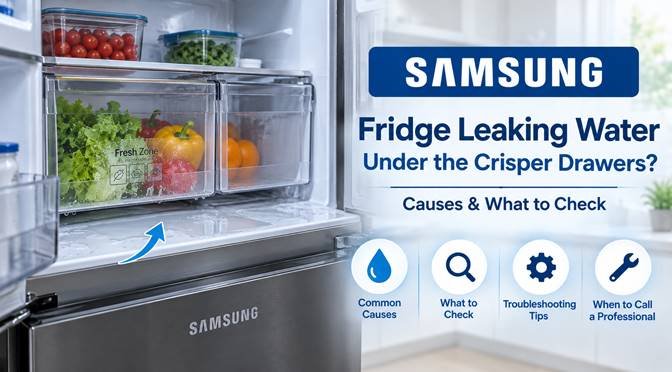
Water collecting under the crisper drawers in a Samsung refrigerator is commonly associated with a drainage or condensation problem. One possible cause is a blocked or frozen defrost drain, which prevents water produced during normal defrosting from leaving the refrigerator correctly.
Instead of flowing through the drain system, water can collect beneath the vegetable drawers, freeze into a sheet of ice or repeatedly reappear after being wiped away.
However, a blocked drain is not the only possibility. Depending on the Samsung model, water inside the refrigerator can also be related to ice build-up, door sealing, condensation, appliance levelling, water-filter connections, ice-maker components or another water-system fault.
If the water keeps returning, finding where it originates is more useful than simply drying the bottom of the fridge.
Why Is Water Collecting Under My Samsung Crisper Drawers?
A frost-free refrigerator regularly removes frost from its evaporator.
When the appliance enters a defrost cycle, that frost melts. The water should then:
- move into a drain channel,
- pass through a drain opening and tube,
- leave the refrigerated compartment,
- collect in the evaporation area below the appliance.
If the drain opening or drainage path is obstructed, the water has nowhere to go.
It may then:
- run underneath the vegetable drawers
- pool inside the refrigerator
- freeze into a sheet of ice
- appear again after the fridge has been cleaned
- eventually leak onto the floor
Diagnostic Takeaway: Where the water appears is therefore an important diagnostic clue.
Common Causes of Water Under Samsung Crisper Drawers
1 Frozen or Blocked Defrost Drain
A restricted defrost drain is one of the first areas worth considering when water repeatedly appears beneath the crisper drawers.
The drain can become affected by:
- ice
- food debris
- residue
- recurring frost around the evaporator or drain area
- drainage components not clearing water correctly
When the refrigerator defrosts, water that should leave the cabinet instead backs up and collects at the bottom.
You may notice:
- water underneath the crisper drawers
- a sheet of ice beneath the drawers
- recurring water every few days
- water freezing and thawing repeatedly
- no obvious external plumbing leak
If the water is returning regularly, the question is not only whether the drain is blocked, but why it is becoming blocked or frozen again.
2 Ice Build-Up Around the Evaporator
Drainage problems and evaporator icing can sometimes occur together.
If heavy frost develops behind an internal rear panel, melting ice can produce more water than the drain is handling correctly.
Depending on the model, recurring ice may involve:
- defrost heater operation
- defrost sensors or thermistors
- fan operation
- drainage
- temperature sensing
- door sealing
- electronic controls
If you also see heavy frost, hear the fan striking ice or notice the refrigerator section becoming warmer, read our guide to Samsung fridge freezing up and defrost problems.
Repeatedly clearing the water without addressing recurring frost may only treat the visible symptom.
3 Defrost System Fault
The automatic defrost system is responsible for managing normal frost on the evaporator.
Depending on the Samsung refrigerator, this may involve:
- a defrost heater
- defrost or temperature sensors
- thermistors
- thermal protection components
- electronic control logic
If frost is not being removed correctly, ice can build around the evaporator and drainage area.
Eventually, this can contribute to:
- water under the drawers
- ice beneath the crisper section
- restricted airflow
- fan noise
- fridge temperature rising
- recurring frost after manual defrosting
The presence of ice alone does not prove that the heater has failed. The relevant components should be tested before anything is replaced.
4 Warm Air Entering Through the Door Seal
Moisture does not always originate from the defrost drain.
Warm, humid room air entering the refrigerator can create condensation inside the cabinet.
Possible reasons include:
- dirty door gasket
- torn or deformed seal
- food preventing the door from closing
- door misalignment
- damaged hinges
- repeated door opening
- refrigerator not positioned correctly
That moisture can collect on cold surfaces and eventually run towards the lower part of the cabinet.
Check that the refrigerator door:
- closes completely
- is not being held open by shelves or containers
- has a clean gasket
- appears to seal evenly around the cabinet
If the gasket is split, badly distorted or pulling away, it may require attention.
5 Refrigerator Not Level
Correct installation can influence door closure and water movement.
If the refrigerator is noticeably out of level, the doors may not close as intended or condensation and defrost water may not behave as expected.
If the problem began after:
- moving the refrigerator
- changing flooring
- relocating the appliance
- adjusting the feet
check that the appliance is sitting securely and according to the installation instructions for the model.
Do not make major adjustments based on a generic setting from another Samsung fridge. Installation requirements can vary.
6 Condensation Inside the Refrigerator
A small amount of moisture can sometimes result from normal use, especially when humid air enters the cabinet.
Condensation can increase when:
- the door is opened frequently
- warm food is placed inside
- containers are uncovered
- the fridge is heavily loaded
- the door is not sealing correctly
- humidity is high
If you only see light moisture occasionally, condensation may be the explanation.
If a substantial pool of water keeps returning beneath the drawers, a drainage or component problem becomes more likely.
7 Water Filter or Water-Line Leak
Samsung refrigerator models fitted with a water dispenser or ice maker can have additional possible leak sources.
Depending on the design, these may include:
- water-filter housing
- filter installation
- water-line connections
- internal tubing
- inlet valve
- dispenser system
A water-system leak does not always appear directly underneath the leaking component. Water can travel along internal surfaces before becoming visible elsewhere.
If the refrigerator has a water connection, check whether the leak:
- becomes worse after dispensing water
- started after changing the filter
- appears near the filter housing
- continues even when the refrigerator is not defrosting
These details can help distinguish a plumbing-related leak from a defrost drainage problem.
8 Ice Maker or Water Supply Problem
Where fitted, the ice-maker system can also introduce water into the refrigerator.
Possible symptoms include:
- water around the ice compartment
- ice clumping together
- frost around the ice bucket
- water appearing after an ice-making cycle
- unusual ice production
- visible dripping
This does not mean every Samsung fridge with water below the crisper drawers has an ice-maker fault.
The location and timing of the leak need to be considered together.
9 A Spill You Did Not Notice
Before assuming a refrigeration fault, rule out the simplest possibility.
A leaking container or spill on an upper shelf can sometimes run down behind drawers and collect underneath the crisper section.
Check:
- bottles
- containers
- produce bags
- shelves
- drawer edges
Clean and dry the area completely.
If water returns without another spill, continue investigating.
Water Under the Drawers vs Water Under the Fridge
These two symptoms can point towards different areas.
Water Under the Crisper Drawers
More likely areas to investigate include:
- defrost drain
- condensation
- internal frost
- door sealing
- water migrating from another internal component
Water on the Floor Under the Refrigerator
Possible areas can include:
- external drain pan area
- water-supply connection
- filter system
- inlet plumbing
- water travelling from an internal leak
- condensation or drainage problem
If you can, note whether the water starts inside the cabinet first or appears directly on the floor.
That information is useful when booking a repair.
Why Does the Water Turn Into Ice Under the Crisper Drawers?
Water can freeze beneath the drawers because the bottom of the refrigerator compartment may be close to cold airflow or refrigerated surfaces.
A common sequence is:
This cycle can continue until the drainage problem is corrected.
An ice sheet does not necessarily mean the refrigerator is set too cold.
Its location and relationship to the drain system matter.
Why Does the Water Come Back After I Clean It Up?
If you remove the water but it returns, the refrigerator is continuing to produce or receive moisture from somewhere.
Possible recurring causes include:
- drain still restricted
- drain repeatedly freezing
- ongoing evaporator frost
- door-seal problem
- condensation
- water-line leak
- ice-maker issue
Cleaning up the water addresses the immediate mess but not necessarily the source.
If the same pool or ice sheet repeatedly appears, further diagnosis is worthwhile.
Can You Check Anything Yourself?
There are several safe checks you can make without dismantling the refrigerator.
Dry the Area Completely
Remove the crisper drawers and dry all visible water.
This makes it easier to determine whether the water returns and where it first appears.
Check for Ice
Look for:
- ice underneath the drawers
- frost on the rear internal panel
- ice around vents
- ice around the freezer or ice-maker area
Heavy recurring frost can indicate that the leak is related to a wider defrost or drainage issue.
Inspect the Door Seal
Make sure the gasket:
- is clean
- has no obvious tears
- makes contact around the door
- is not obstructed by food
Make Sure the Door Closes Fully
Large containers, drawers that are not seated correctly or food packages can prevent complete closure.
Check the Water Filter
If your Samsung refrigerator has a water filter and the leak started after a replacement, check that the correct filter has been fitted and installed according to the manufacturer's instructions.
Check for Error Codes
If a code or warning appears, record it.
Our Samsung fridge error codes guide explains common Samsung refrigerator messages and what they can indicate.
Should You Remove the Rear Panel to Clear the Drain?
For most homeowners, removing internal refrigerator panels is not the best first step.
Behind refrigerator panels you may encounter:
- electrical wiring
- sensors
- fan assemblies
- heaters
- evaporator tubing
- sharp metal components
Panels can also become frozen in place.
Forcing a panel away can damage:
- wiring
- insulation
- plastic components
- evaporator tubing
Crucial Technical Insight: A damaged evaporator can turn a comparatively straightforward drainage or defrost problem into a much more serious refrigeration repair. If the drain cannot be accessed without dismantling the refrigerator, professional diagnosis is the safer option.
Should You Use a Hairdryer to Melt the Ice?
We would not recommend directing concentrated heat at refrigerator components.
High heat can damage:
- plastic panels
- insulation
- wiring
- sensors
- seals
Safety Warning: Sharp tools should also never be used to chip ice away. If a temporary defrost is needed, switching the refrigerator off and allowing hidden ice to melt naturally is generally safer. Protect the floor from water and make appropriate arrangements for refrigerated and frozen food.
Will Defrosting Fix Water Under the Crisper Drawers?
It may temporarily remove the immediate blockage if the drain is frozen.
However:
melting the ice is not always the same as repairing the fault.
If the water or ice returns after the refrigerator has been fully defrosted, possible underlying causes include:
- recurring drain freezing
- defrost-system fault
- temperature sensor issue
- excessive frost
- door sealing
- electronic control problem
Repeated defrosting should not be necessary for normal operation.
What About the Samsung Drain Clip?
You may find online discussions recommending modified or extended drain-heater clips for particular Samsung refrigerators.
Do not assume a specific clip, modification or part number is suitable for your model.
Samsung refrigerator designs vary considerably by model and production series.
Before installing or modifying anything around a heater or evaporator, the technician should confirm:
- exact model
- existing component design
- whether the drain is actually freezing
- whether another defrost fault is present
- correct replacement or service procedure
An online fix that applies to one Samsung refrigerator may not apply to another.
How a Technician Diagnoses Water Under Samsung Crisper Drawers
The repair should start by identifying where the water is coming from.
Depending on the refrigerator, diagnosis can include:
Inspecting the Drainage Path
The technician may check whether defrost water can pass through the drain correctly.
Looking for Ice Around the Evaporator
Heavy frost can indicate that the drainage problem is part of a broader defrost or airflow fault.
Checking Defrost Components
Where appropriate, testing may include:
- heater operation
- thermistors
- defrost sensors
- wiring
- electronic controls
Checking Door Sealing
Warm-air infiltration can contribute to condensation and recurring frost.
Inspecting the Water System
On plumbed models, the filter, connections, tubing, valves or ice-maker system may need to be checked.
Confirming Refrigerator Temperature
Actual cabinet temperature can provide context about whether the leak is occurring alongside a cooling problem.
What if the Fridge Is Also Not Cooling Properly?
Water under the drawers combined with a warm refrigerator can point towards a related frost, airflow or defrost problem.
For example:
The exact sequence depends on the model.
Is a Samsung Fridge Leaking Water Worth Repairing?
Often, yes.
Water underneath the crisper drawers does not automatically mean the refrigerator has a major sealed-system failure.
Depending on the diagnosis, the issue may involve:
- drainage
- defrost components
- door seal
- sensor
- water connection
- ice-maker component
- electronic control
Whether repair makes sense depends on:
- exact fault
- refrigerator age
- overall condition
- repair history
- parts availability
- repair cost
- replacement cost
Diagnosis is more useful than deciding based on the water leak alone.
When Should You Call a Samsung Fridge Technician?
Professional inspection is sensible when:
- water keeps returning under the crisper drawers
- a sheet of ice repeatedly forms
- the refrigerator is also warming
- heavy frost is visible
- the evaporator fan is becoming noisy
- the drain repeatedly freezes
- water appears without an obvious spill
- the fridge has a water-system leak
- an error code is displayed
Water and ice can affect food storage, internal components, flooring and cabinetry, so recurring leaks are worth addressing.
Samsung Refrigerator Leak Repairs in Sydney
Fast Fridge Repairs provides independent Samsung refrigerator repairs in Sydney for suitable models with problems including:
- water under crisper drawers
- frozen or restricted drainage
- recurring ice build-up
- defrost faults
- fridge not cooling
- freezer problems
- fan faults
- sensor problems
- error codes
- water-system leaks
Fast Fridge Repairs has more than 20 years of refrigeration experience, is ARCtick licensed, and provides a 12-month parts warranty on parts supplied by us.
Notice of Independence: We are an independent refrigeration repair business and are not represented as an authorised Samsung service centre. If your refrigerator may still be covered by Samsung's manufacturer warranty, check the applicable warranty options before arranging independent repair.
Frequently Asked Questions
A blocked or frozen defrost drain is one possible cause, but condensation, door sealing, frost, water-system components or model-specific faults can also produce water underneath the drawers.
Defrost water may be collecting in the bottom of the refrigerator and freezing instead of draining away. The drain opening, recurring frost and defrost system may need to be checked.
Yes. If water produced during defrosting cannot leave through the drain, it may overflow into the refrigerator compartment and collect beneath the drawers.
If the water returns, the source has not been corrected. The drain may still be restricted, frost may be recurring or another condensation or water-system issue may be present.
A poorly sealing door can allow warm humid air inside, increasing condensation and frost. Whether it is responsible for water beneath the drawers depends on the refrigerator and where the moisture is forming.
A complete power-off defrost may melt a temporary ice blockage, but the problem can return if an underlying defrost, drainage, sensor or sealing fault remains.
A small amount of water does not automatically mean major damage, but recurring leaks can contribute to ice build-up, cooling problems and potential damage to surrounding flooring or cabinetry.
Not necessarily. Many internal water leaks are associated with drainage, defrost, sealing or water-system components. The fridge should be diagnosed before deciding whether replacement is justified.
Water Keeps Returning Under Your Samsung Fridge Drawers?
If you are repeatedly wiping up water, removing sheets of ice or finding the same leak beneath the vegetable drawers, the refrigerator needs more than another clean-up. Fast Fridge Repairs can identify whether the problem is related to drainage, recurring frost, defrost components, door sealing or the refrigerator's water system and explain the appropriate repair options.
