


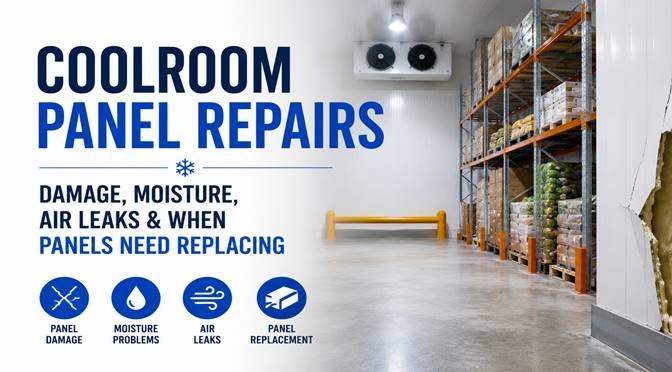
A dent in a coolroom wall does not always mean the panel needs replacing. A puncture from a trolley or forklift is different. So is a panel that has started bulging, separating at the joints or showing moisture around the base.
From a refrigeration point of view, the important question is not simply how the panel looks. It is whether the damage has affected the thermal envelope of the coolroom.
Coolroom walls and ceilings are designed to separate a cold, controlled space from warmer surrounding air. Once panel skins, joints, seals or insulated cores are compromised, warm air and moisture can find their way into places they should not be. That can contribute to condensation, frost, longer refrigeration run times and continuing deterioration of the panel itself.
This guide explains the common types of coolroom panel damage, what can sometimes be repaired, when replacement deserves consideration, and how to distinguish a panel problem from a refrigeration-system fault.
What Is a Coolroom Panel?
Most commercial coolrooms are constructed from insulated sandwich panels. A typical panel consists of:
- An outer metal skin
- An insulated core
- An inner metal skin
- Interlocking or sealed panel edges
The exact core material and joining system varies between installations. The panels form the walls and ceiling of the coolroom and help slow heat transfer between the refrigerated space and the surrounding environment.
Good panel performance depends on more than insulation thickness. The complete enclosure also requires:
- Properly closed panel joints
- Intact surface skins
- Sealed penetrations
- Sound corners and trims
- Appropriately sealed floor and wall interfaces
- A door that closes and seals correctly
A good refrigeration system cannot compensate indefinitely for a badly damaged enclosure.
Do Dented Coolroom Panels Need Repair?
Not every dent requires major work. A shallow surface dent that has not punctured the metal skin, opened a panel joint, crushed the insulation significantly, distorted a corner, affected a door opening, or created a gap around the panel may be largely cosmetic.
This is particularly common in busy storage areas where boxes, trolleys or stock occasionally contact the walls.
The concern increases when the damage is deep, sharp or open. A severe impact can split the metal skin, expose insulation, crush the panel core, deform the joint, create a path for moisture, and affect how adjacent panels meet. That is no longer just an appearance issue.
Common Causes of Coolroom Panel Damage
Forklift and Pallet Impact
Forklift tines and pallets can cause some of the most serious coolroom wall damage. A tine can puncture the outer skin and penetrate the insulated core. Even if the opening appears small, it can provide a direct path for moisture. Damage near the bottom of panels is especially common because this is where stock-moving equipment operates.
Trolleys and Stock Handling
Repeated lower-level impacts can gradually dent and distort wall surfaces. Individual dents may be minor, but repeated damage can eventually affect panel skins, corner protection, lower channels, joints, and sealing. Protection rails or barriers are worth considering in areas where repeated impacts occur.
Water and Cleaning
Coolrooms need regular cleaning, but damaged joints or poorly sealed panel bases can allow wash water to enter vulnerable areas. A published Australian coolroom hygiene guide specifically recommends monitoring panel slip joints and sealant at the panel base because water ingress can lead to panel deterioration.
Age and Movement
Over time, structural movement, repeated door use, failing sealant or historical modifications can create gaps at panel connections, leading to separated joints, cracking sealant, loose trims, and small gaps around penetrations.
Why Coolroom Panel Joints Matter
Panel joints are easy to overlook because the refrigeration equipment usually receives most of the attention. But the joins between panels are part of the coolroom's air and moisture barrier.
When joints are properly assembled and sealed, they help prevent warm, moisture-laden air from moving into the enclosure or insulation. When a joint opens, several issues can develop:
- Warm air can enter the coolroom.
- Moisture can condense where warm and cold surfaces meet.
- The refrigeration system must remove additional heat and humidity.
- Frost can develop directly along the affected seam.
Signs a Coolroom Panel Joint May Be Failing
- Visible gaps between panels
- Cracked or missing sealant
- Condensation running along a joint
- Ice repeatedly appearing along the same seam
- Staining or discolouration
- Panels beginning to separate or bow
- Damaged capping or exposed core insulation
- Moisture pooling around the panel base
One wet joint does not automatically prove the insulation has failed. Water can also originate from a blocked evaporator drain, defrost run-off, a leaking pipe, or cleaning water. Diagnosis matters because resealing a panel will not solve a leaking refrigeration drain.
Moisture Inside Coolroom Panels
Moisture ingress is one of the most serious panel problems. The insulated core is engineered to remain dry and protected inside the metal skins.
Once water enters through a puncture, failed joint or poorly sealed base, repeated cold conditions worsen the damage. Moisture entering a panel can freeze and expand, causing panels to bulge and seals to break further, allowing additional moisture-laden air into the structure.
Warning Signs of Internal Core Saturation
Watch for swelling or bulging panels, blistered-looking surfaces, recurring moisture along one seam, corrosion, and panel distortion. Once the insulated core is saturated, simply applying surface sealant will not restore thermal integrity.
Can a Moisture-Damaged Coolroom Panel Be Repaired?
It depends on how far the damage has progressed:
- Repairable: A small localised opening discovered early where the core is dry, the panel remains structurally straight, and the area can be thoroughly dried and resealed.
- Replacement Required: When the core is saturated, the panel is swollen, extensive corrosion has formed, or the structural shape cannot be recovered.
Why Coolroom Panel Damage Can Affect Refrigeration Performance
A compromised enclosure increases the heat and moisture load entering the cold room. The refrigeration unit must run longer and work harder to maintain temperature.
Common operational symptoms include:
- Extended compressor run times
- Sluggish temperature recovery after door openings
- Heavy condensation on interior walls
- Frost build-up around damaged seams
- Excessive ice accumulation on the evaporator coil
However, these symptoms can also result from mechanical faults like dirty condensers, fan failures, low refrigerant charge, or defrost malfunctions. If temperature performance has degraded, Fast Fridge Repairs' commercial coolroom repair service covers full diagnostic testing of the refrigeration system alongside enclosure checks.
Coolroom Panel Damage vs Door Seal Problems
Both issues allow unwanted warm, humid air into the space. The difference is the point of infiltration:
Possible Door Problem
- Damaged or torn door gasket
- Light visible around the closed door perimeter
- Door not hanging square or sagging hinges
- Difficulty latching or closing fully
- Condensation concentrated near the doorway
Possible Panel Problem
- Open wall seam or separated joint
- Damaged metal skin or forklift puncture
- Bulging or blistered panel surface
- Moisture forming well away from doorways
- Frost tracking along a specific panel seam
Coolroom Ceiling & Doorway Panel Damage
Coolroom Ceiling Panel Damage
Ceiling damage deserves particular care. Ceiling panels often interact with structural suspension systems. Warning signs like sagging, separation, water staining, condensation, or loose fixings require prompt structural assessment. Never hang equipment from insulated ceiling panels unless specifically engineered for the load.
Damage Around Coolroom Doors and Frames
Doorways are subjected to continuous mechanical stress. If impact damage twists the frame out of square, the door will not seal properly, triggering a costly cycle of warm air infiltration, heavy icing, and elevated power bills.
When Does a Panel Need Replacing Rather Than Repairing?
Replacement becomes the sensible path when:
- The insulated core is crushed or exposed: Structural and thermal capacity is permanently lost.
- Moisture has spread throughout the core: Surface patches cannot fix soaked insulation.
- The panel is bulged or distorted: The joint interface will no longer hold an airtight seal.
- Corrosion is extensive: Rust along base channels compromises hygienic containment.
- Hygiene standards cannot be met: Food safety authorities require smooth, easily cleanable surfaces.
Hygiene Standards & Forklift Impact Protocols
Food Standards Australia New Zealand (FSANZ) requires food-premises walls and ceilings to be impervious and easily cleaned. Deep punctures, exposed foam, or rusting skins compromise food safety compliance.
What to Do Immediately After a Forklift Impact:
- Check if the metal skin has been punctured or insulation exposed.
- Inspect adjacent vertical joints to see if seams have popped open.
- Look for bulging on the reverse side of the wall.
- Take clear photographs for repair and insurance documentation.
- Do not wash the area with high-pressure hoses if insulation is exposed.
Panel Fault or Refrigeration Fault? Quick Guide
| What You Notice | Possible Direction |
|---|---|
| Small dent, room temperature normal | Often cosmetic, no immediate action needed |
| Deep puncture with exposed insulation | Panel repair or section replacement needed |
| Panel bulging or swelling | Possible internal moisture ingress and freezing |
| Frost along one panel seam | Check joint sealing, sealant integrity and room humidity |
| Water under evaporator | Drainage or refrigeration defrost fault more likely |
| Whole room warming | Check refrigeration system performance alongside envelope |
| Frost concentrated around door | Door gasket, heater wire, or frame alignment issue |
| Cracked panel beside door frame | Panel and door alignment both need inspection |
| Compressor running longer after impact | Check enclosure air tightness and system performance |
| Repeated temperature alarms | Full coolroom diagnostic assessment required |
Frequently Asked Questions
Can damaged coolroom panels be repaired?
Yes. Shallow dents, localised skin tears, or failing sealant joints can be repaired if the internal insulated core remains dry and structurally sound. Panels with widespread core saturation or severe distortion require replacement.
Does a dent in a coolroom panel affect insulation?
A shallow surface dent typically has negligible effect. Deep impacts that crush the polyurethane or polystyrene core reduce thermal efficiency and create air gaps where moisture can accumulate.
What happens if water gets inside a coolroom panel?
Water compromises the insulation properties. In low-temperature freezers or coolrooms, freeze-thaw cycles cause the trapped water to expand, bowing the metal skins and splitting joint seals further.
Can a forklift-damaged coolroom panel be repaired?
Shallow dents can be capped or reinforced. If the forklift tine has punctured the core or displaced the joint alignment, cutting out the damaged section or replacing the full panel is generally required.
Can failed coolroom panel joints cause frost?
Yes. When warm, moisture-laden air is drawn through an open seam into the cold room, the moisture condenses and freezes directly along the joint.
Why are my coolroom wall panels bulging?
Bulging is a prime indicator of internal moisture ingress that has expanded upon freezing, or severe structural movement causing the panel core to delaminate from the skin.
Do coolroom ceiling panels need replacing if they sag?
Sagging ceiling panels pose safety and thermal risks. They should be assessed immediately to determine if the issue stems from saturated insulation, joint failure, or compromised suspension fixings.
Can panel leaks make a coolroom struggle to hold temperature?
Yes. Significant air leaks add continuous thermal load. However, failing fans, dirty coils, or low refrigerant produce identical symptoms, so both the room enclosure and refrigeration machinery should be evaluated.
Should I reseal coolroom panels myself?
Applying silicone over a dirty, damp, or moving joint is a temporary cosmetic fix. The joint must be dry, structurally aligned, and sealed with food-safe, low-temperature neutral-cure sealant.
Who should inspect damaged coolroom panels?
Refrigeration technicians diagnose cooling machinery and temperature faults, while major panel rebuilds may involve specialist panel installers or commercial coolroom installation professionals.
When to Arrange a Coolroom Assessment
If your commercial coolroom has sustained panel impact, is developing recurring seam ice, or is struggling to hold temperature, an expert diagnostic check identifies whether the issue lies in the thermal envelope or the cooling system.
Fast Fridge Repairs provides comprehensive commercial coolroom diagnosis, repairs, and servicing across Sydney.