


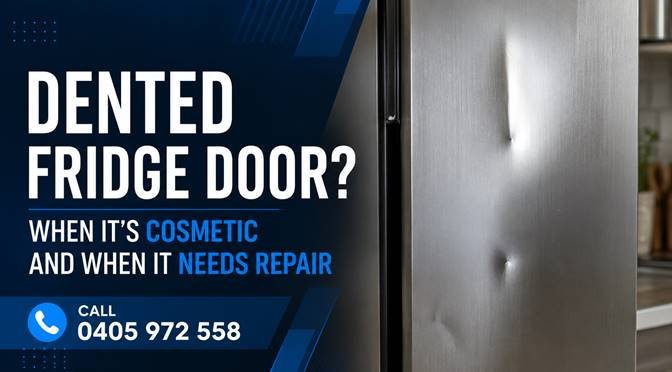
A dent in a fridge door can be irritating, especially on a stainless steel refrigerator where even a shallow mark catches the light. But a dent does not automatically mean the fridge needs repairing.
If the door still closes squarely, the gasket seals all the way around and the refrigerator is maintaining temperature normally, a small dent in the outer skin is often cosmetic rather than a refrigeration fault.
The situation changes when the impact affects the door edge, hinge area, gasket surface, internal liner, dispenser or the way the door sits against the cabinet. A damaged door that no longer seals properly can allow warm, humid air into the fridge, contributing to condensation, frost and poor temperature performance.
Is a Dent in a Fridge Door a Problem?
Start with function, not appearance.
A shallow dent in the middle of the outer door panel may look bad without affecting the refrigerator at all. Refrigerator panels also contain insulation behind their inner and outer surfaces, and minor panel irregularities do not necessarily indicate a functional defect.
LG, for example, notes that some small indentations or flexing can occur as insulation expands between refrigerator panels and that minor examples do not affect appliance performance. Severe deformation is a different matter and should be assessed.
A fridge-door dent becomes more concerning when you notice any of the following warning signs at the same time:
- The door no longer sits evenly or squarely
- The gasket has a visible gap
- The door does not stay closed firmly
- Condensation forms around the opening
- Frost begins appearing near the door frame
- The compressor seems to run much longer than before
- Cabinet temperature starts increasing
- The hinge or door corner has been distorted
- The internal door liner is cracked or split
- A water dispenser, display or other door-mounted feature stops working
The dent itself is not always the real problem. What matters is what the impact changed structurally.
Dent or Door Problem? A Quick Checklist
Use this diagnostic checklist to quickly separate purely cosmetic marks from functional issues requiring professional assessment:
Probably Harmless
- Shallow, smooth rounded depression
- Located in the centre of the panel
- Well away from edges and hinges
- Door opens, closes and latches normally
- Gasket sits flush and seals completely
- No new frost, moisture or condensation
- Internal temperatures remain accurate
- No cracks inside the internal liner
- No dispenser or electrical issues
Worth Repair Assessment
- Dent reaches or deforms the door edge
- Impact occurred near a hinge area
- Door has dropped, twisted or rubs
- Gasket no longer seals (visible gaps)
- Door bounces or will not remain closed
- Inner plastic liner is cracked or distorted
- Frost/ice appeared after the impact
- Compressor runs non-stop / temperature rises
- Dispenser, display or ice maker stopped working
When a Fridge Door Dent Needs More Attention
1. The Door No Longer Seals Properly
This is one of the most important checks. The refrigerator gasket needs even contact with the cabinet around the entire door opening. If an impact twists the door or deforms the sealing edge, cold air can escape and warm, moist air can enter.
Manufacturers including Electrolux and Samsung identify damaged or poorly seated door seals as causes of door-closing and cooling problems. Samsung also notes that a door that does not close properly can contribute directly to frost formation.
Look around the entire gasket for warning signs:
- Visible gaps between gasket and frame
- A section of gasket sitting pulled away from the cabinet
- Condensation or sweating near one corner
- Frost forming around the internal opening
- The door springing back open when pushed shut
- Noticeably weaker magnetic gasket pull in one area
2. The Dent Is Near a Hinge or Door Corner
A dent in the centre of the panel and a dent at the hinge side are very different problems. The hinges carry the weight of the entire door. An impact near a hinge, lower corner or upper corner can potentially throw off alignment even if the visible metal crease looks small.
Check whether:
- The reveal gaps around the door are still even
- The door has dropped on one side
- It rubs against an adjoining door (on French door models)
- It requires lifting to latch properly
- The gasket meets the cabinet evenly
3. The Door Has a Sharp Crease
A smooth, shallow depression sometimes has the ability to move back towards its original shape. A sharp crease is completely different.
Once thin door metal has been stretched or sharply folded, restoring a factory-flat finish becomes much harder. Pulling on it may reduce the depth without removing the crease line, which is why DIY fridge dent removal often produces disappointing results.
4. The Inner Door Liner Is Damaged
Open the refrigerator and inspect the inside plastic surface opposite the impact. Cracking, splitting or distortion of the inner liner suggests the impact was structural rather than superficial.
Refrigerator doors are insulated structures rather than hollow sheets of metal. Many have rigid foam between the inner and outer surfaces, which provides structural rigidity and insulation. Trying to puncture the inner liner to hammer a dent outward can destroy thermal efficiency and ruin the door.
5. Door-Mounted Electronics or Water Components Stop Working
Modern fridge doors carry substantial technology. Depending on the model, a door can house display electronics, control switches, wiring harnesses, water lines, dispenser assemblies, ice-maker mechanisms, heaters and sensors.
If an impact causes a display, dispenser or ice maker to fail, the issue must be assessed as an electrical or plumbing fault rather than simple cosmetic damage.
Can You Remove a Dent From a Stainless Steel Fridge?
Sometimes, but expectations must be realistic. A small, shallow, smooth dent offers a much better chance of improvement than deep creases, edge impacts, stretched panels or damage near handles.
Even professional-grade dent removal may leave subtle distortions visible under reflective kitchen lighting. A better question than "Can it be pulled out?" is "Can it be improved without making the door finish or structure worse?"
Suction Cups & Hot-Glue Pullers
Paintless dent pullers and suction tools may improve some smooth dents, but they rarely restore factory-flat finishes. Thin appliance metal is backed by dense polyurethane insulation that limits movement.
Hot-glue methods also require chemical adhesives that can strip fingerprint-resistant coatings from stainless steel surfaces.
Hairdryer & Canned Air (Thermal Shock)
The popular internet trick relies on rapid expansion and contraction. However, results on appliance metal are unpredictable.
Excessive heat can melt internal adhesives, damage plastic trim, warp magnetic door gaskets or permanently scorch protective clear coatings.
Dry Ice Techniques
Applying dry ice introduces extreme cold shock. It is completely unnecessary for diagnostic purposes and presents risks of surface finish damage, coating cracking and severe personal skin burns.
Automotive Body Filler & Paint
Using Bondo or body filler is auto bodywork, not appliance repair. On brushed stainless steel, sanding permanently ruins the directional grain pattern, color matching is nearly impossible, and the repair will stand out under light.
When Is Door Replacement the Better Option?
When impact damage compromises structure, sealing or internal electronics, replacing the door assembly or outer skin is often the cleanest solution.
Door replacement becomes sensible when:
- The dent has a sharp, stretched crease that cannot be leveled
- The door edge or corner is permanently distorted
- The internal door liner is split or cracked
- The door fails to create an airtight seal with the cabinet
- There are multiple large impact depressions
- A built-in dispenser or electronic housing is cracked
Why a Poor Door Seal Becomes a Major Cooling Problem
A refrigerator maintains a tightly controlled internal climate. When a dented frame or twisted hinge prevents proper sealing, a continuous cycle begins:
Warm room air enters → Moisture enters → Cooling load surges → Heavy condensation/frost develops → Compressor runs continuously
While a leaky seal might not destroy the compressor instantly, it forces the entire cooling circuit to operate under severe strain. That is why edge and corner dents must never be ignored.
New Fridge Arrived Dented? What You Should Do
If your refrigerator arrived brand new with a dent, do not attempt any DIY repairs. Take high-resolution photos of the damage, packaging and serial number immediately and contact your retailer.
Under Australian Consumer Law (ACL), products sold must meet consumer guarantees of acceptable quality and appearance. Depending on whether the fault is major or minor, remedies include repair, door replacement or a full refund. Applying heat, glue or suction tools before contacting the supplier can void your warranty and complicate claims.
How to Prevent Fridge Door Dents & When a Tech Is Needed
Most door damage occurs during routine household activities or house moves. A few basic precautions can protect your investment:
- Ensure adjacent kitchen cabinet handles or oven doors cannot strike the fridge panel
- Position door stops if the refrigerator opens close to a masonry wall
- Never use refrigerator doors as leverage or support when moving heavy kitchen items
- Wrap appliances in padded furniture blankets before moving house
- Ensure French-door refrigerators are levelled correctly so doors close smoothly without colliding
The Bottom Line: Cosmetic vs Operational Faults
A dented fridge door is usually a harmless cosmetic issue if the door hangs straight, closes squarely, seals airtight, and maintains its set temperature without excess frost.
However, if the impact causes air leaks, hinge sagging, frost build-up, liner cracks or cooling failures, proper diagnosis is required.
Fast Fridge Repairs provides dedicated residential and commercial refrigeration diagnostics across Sydney. If your refrigerator has developed a temperature, seal or electrical fault following an impact, professional assessment ensures the underlying refrigeration system remains protected.
Frequently Asked Questions
Can a dent in a fridge door be repaired?
Small, smooth, shallow dents can sometimes be improved using paintless dent tools. Sharp creases, stretched metal and edge impacts are significantly harder to level cleanly. If the dent impairs the gasket seal or hinge, functional repair or door replacement is necessary.
Is a dented refrigerator safe to use?
A shallow cosmetic dent in the outer metal skin does not make a fridge unsafe. However, if the impact was severe enough to crack the internal liner, expose wiring, damage the dispenser or prevent the door from sealing, a professional inspection is recommended.
Can you remove a dent from a stainless steel fridge?
Some shallow dents on stainless steel can be improved with specialist tools. Completely invisible removal is rare because appliance door skins are thin and backed by rigid insulation foam that restricts metal reshaping.
Will a dent affect fridge cooling performance?
Not if the dent is strictly cosmetic. A dent only impacts cooling performance if it twists the door, warps the magnetic gasket, or creates air gaps that allow warm, humid room air into the cabinet.
Should I use a hairdryer or heat gun to pop out a fridge dent?
We do not recommend aggressive heating. Extreme heat can scorch clear coatings, melt plastic trims, warp magnetic door seals and damage the polyurethane insulation foam inside the door panel.
Can a fridge door be replaced?
Yes. Many manufacturers supply replacement outer skins or complete door assemblies. Availability and cost depend on the brand and model number.
Experiencing Cooling or Door Sealing Problems?
If your refrigerator is failing to maintain temperature, leaking cold air, icing up or struggling after an impact, arrange an on-site diagnosis with Fast Fridge Repairs across Sydney.