


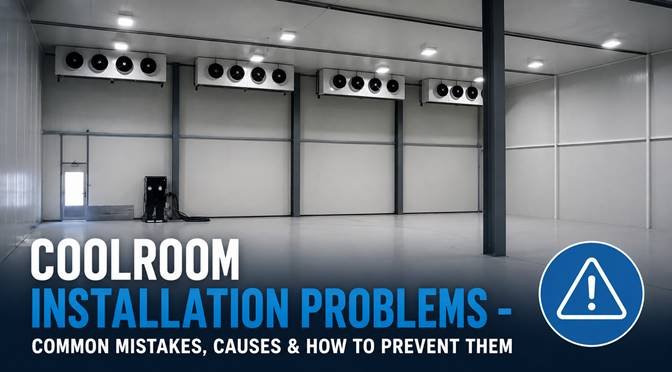
A newly installed coolroom can look perfectly finished and still struggle once it is loaded with stock and put into daily use.
The temperature may recover too slowly after deliveries. One side of the room may stay warmer than another. Water can start appearing beneath the evaporator. Ice may form around the doorway, the compressor may run for unusually long periods, or the system may cope during mild weather but struggle on hot days.
These problems do not automatically mean the compressor is faulty.
A commercial coolroom works as one complete refrigeration system. Room size, floor design, door traffic, refrigeration capacity, evaporator airflow, condenser ventilation, drainage, temperature controls and commissioning all affect how reliably the room performs.
With more than 20 years working with refrigeration systems, one lesson is particularly important: many expensive coolroom problems can be avoided by getting the design and installation decisions right before the room starts operating.
This guide covers the installation mistakes and design issues worth checking when planning a new coolroom, as well as the symptoms that can indicate an existing room was not set up correctly.
Why Coolroom Installation Problems Do Not Always Appear Immediately
Some installation faults are obvious from the first day. A badly aligned door may never close correctly. An evaporator drain with insufficient fall can start overflowing during early operation. An incorrectly located temperature sensor may give misleading readings as soon as the system starts.
Other problems can remain hidden for weeks or months:
- A marginally sized refrigeration system may cope when the room is lightly loaded
- Poor condenser ventilation may become obvious only during hot weather
- Inadequate airflow may become a problem once shelving and stock are added
- Frequent door openings may expose insufficient refrigeration capacity
- A poorly designed freezer floor may develop subfloor frost heave gradually
This is why professional coolroom installation in Sydney should consider how the room will operate during real trading conditions, not simply whether it can reach temperature while empty.
16 Critical Coolroom Installation & Design Mistakes
Choosing the Wrong Coolroom Size
Coolroom sizing is not simply a question of fitting the biggest room possible into the available space. The installer needs to understand what will be stored, how much stock will be inside, how employees will access it and how air will circulate once shelving is installed.
A room that is too small can quickly become overcrowded, forcing stock directly beneath the evaporator, blocking return airflow, and obstructing doorway circulation. Conversely, an unnecessarily large room increases surface area heat gain and energy costs.
Key Factors to Sizing: Normal and peak stock volume, shelving configuration, trolley/pallet access, product pull-down requirements, delivery frequency, and door-opening patterns.
Installing the Coolroom on an Unsuitable Base
The floor or slab beneath the coolroom affects the alignment of everything built above it. If the installation surface is significantly uneven, assembling the room square and plumb becomes difficult.
Potential Consequences: Door frame racking, uneven gasket compression, joint separation, and drainage flow issues. The supporting slab must be checked for level, moisture barriers, and load-bearing capacity prior to panel assembly.
Using the Wrong Floor Design
A chilled coolroom (+2°C to +4°C) and a freezer room (-18°C to -22°C) require fundamentally different floor construction.
Freezer Rooms: Sustained sub-zero operation requires dedicated underfloor insulation, vapour barriers, and thermal breaks. Without appropriate substrate protection, continuous cold migration into the concrete slab causes subfloor moisture to freeze, expand, and crack the slab (frost heave).
Poor Drainage Planning
Water issues in coolrooms are frequently drainage design errors rather than refrigeration machinery breakdowns:
- Evaporator Condensate Drainage: Must have adequate fall (gradient), short runs, and drain line heaters in freezer applications to prevent ice blockages.
- Wash-Down Drainage: Floors must feature graded falls toward floor wastes to prevent pooling water and biological contamination.
Incorrect Refrigeration-System Sizing
Cooling capacity must be calculated using full heat-load calculations rather than room volume alone. Heat load factors include ambient outdoor extremes, daily door-opening frequency, warm incoming product mass, lighting, fan motors, and internal occupancy.
Undersized Systems: Run continuously, lose temperature during deliveries, and struggle on 35°C+ summer days. Oversized Systems: Short-cycle, fail to dehumidify properly, and cause premature component wear.
Installing the Condenser Where It Cannot Reject Heat
The condensing unit rejects all extracted room heat into the surrounding atmosphere. Locating condensers in unventilated plant rooms, cramped ceiling voids, or tight corners causes hot-air recirculation.
This elevates head pressure, triggers high-pressure safety trips, cuts cooling capacity, and accelerates compressor burnout.
Poor Evaporator Position and Air Distribution
Cold air must reach every corner of the storage space. If the evaporator blows directly into high shelving or return air is blocked by stock, airflow short-circuits back into the unit.
This causes the temperature sensor near the coil to satisfy and cycle off while stock at the far end remains dangerously warm.
Poor Door Position, Alignment or Selection
The doorway is the primary point of thermal and humidity infiltration. Installing door frames out of square prevents magnetic gaskets from compressing evenly, allowing humid air to enter continuously.
This creates doorway ice accumulation, sweating walls, and extended compressor run times.
Poorly Planned Refrigeration, Drain and Electrical Services
Uncoordinated service penetrations create thermal bridges and air leaks. Every pipe, conduit, and drain penetrating the insulated wall must be detailed with vapour-sealed escutcheons and closed-cell foam insulation.
Installing the Temperature Sensor in the Wrong Position
A sensor mounted directly in the cold discharge air stream registers a false low reading, shutting off the system before the room cools. Placing it too close to the door registers false high readings, overworking the compressor. Sensors must sit in representative return-air zones.
Incorrect Defrost Setup
Inadequate defrost frequency or short durations allow ice to encase evaporator coils, blocking airflow. Excessive defrosting adds unnecessary thermal load to the room. Defrost termination sensors and fan delay timers must be calibrated to room humidity.
Poor Electrical Planning
Failing to establish total connected electrical loads (compressor, fans, defrost heaters, drain heaters, door frame heaters, controllers) leads to nuisance breaker trips and voltage drops that damage compressor motor windings.
Unsupported Equipment and Poor Ceiling Planning
Insulated sandwich ceiling panels are not structural load-bearing floors. Heavy commercial evaporators, pipe runs, and cable trays require independent suspension hangers tied into the building’s primary structural steelwork.
Forgetting Future Maintenance Access
Refrigeration systems require routine maintenance. Installing condensing units or evaporators hard against walls prevents technicians from cleaning coils, replacing fan motors, or servicing expansion valves without expensive dismantling.
Treating Commissioning as "Switch It On and See If It Gets Cold"
Proper commissioning requires systematic pressure testing, deep vacuum evacuation (below 500 microns), precise refrigerant charging by weight, superheat/subcooling measurements, and a supervised pull-down temperature test under load.
Assuming a DIY Cooling System Equals Commercial Refrigeration
Converting domestic air conditioners with external controllers (e.g. CoolBot) has strict limitations. They are not engineered for sub-zero freezer use, have limited humidity extraction, struggle during frequent commercial door traffic, and lack the robust continuous-duty ratings of commercial refrigeration plants.
Signs Your Coolroom May Have an Installation Problem
| Symptom | Possible Installation-Related Cause |
|---|---|
| Coolroom struggles during hot weather | Undersized capacity or restricted condenser ventilation |
| Temperature rises during busy trading | System sizing, excessive door traffic, or airflow restriction |
| One side of room stays warmer | Evaporator position, short-cycling, or obstructed circulation |
| Controller reads correctly but stock is warm | Sensor placed directly in discharge air stream |
| Water appears below evaporator | Insufficient drain fall, blocked trap, or frozen line |
| Ice repeatedly forms near door | Door frame out of square, worn gasket, or warm air infiltration |
| Door does not close or latch evenly | Frame racking due to an uneven slab base |
| Compressor runs for very long periods | Excessive heat load, inadequate capacity, or condenser airflow |
| Evaporator repeatedly ices over | Defrost parameters, drainage issue, or high moisture load |
| System trips on high pressure in summer | Condenser hot-air recirculation or lack of clearance |
| Freezer floor moves or cracks | Subfloor freezing (frost heave) from missing thermal break |
| Problem existed from first day of operation | Commissioning error, improper wiring, or sizing defect |
Installation Problem or Refrigeration Repair Problem?
Installation & Design Issues
- Refrigeration equipment incorrectly sized
- Condenser located in unventilated area
- Evaporator positioned poorly for room shape
- Sensor mounted in discharge airflow
- Insufficient drain gradient or trap design
- Door frame installed out of square
Operational Component Wear
- Evaporator or condenser fan motor failure
- Blocked drain from biological slime
- Split or hardened door gasket
- Burnt defrost heater element
- Refrigerant leak from mechanical vibration
- Compressor electrical start relay failure
Comprehensive Pre-Installation Checklist
- Storage Requirements: Detail product types, entry temperatures, and required pull-down speeds.
- Room Layout: Plan shelving and aisleways to ensure unobstructed evaporator air return.
- Door Usage: Factor in traffic frequency, strip curtains, and clear threshold access.
- Slab & Floor Base: Ensure laser-level slab preparation and subfloor insulation on freezers.
- Refrigeration Plant: Calculate total heat load for 40°C+ ambient summer conditions.
- Services & Controls: Plan penetrations, dedicated circuits, and correct sensor placement.
- Maintenance Access: Ensure 360-degree service clearance around all major machinery.
- Commissioning Protocol: Require formal pressure testing, vacuum hold, and pull-down verification.
Frequently Asked Questions
Why is my newly installed coolroom not getting cold enough?
Possible causes include incorrect refrigeration capacity, poor condenser ventilation, evaporator airflow problems, sensor or controller setup, excessive heat load or a refrigeration-system fault. The entire system should be assessed before assuming the compressor is responsible.
Why does my coolroom work at night but struggle during the day?
Higher surrounding temperatures, increased door traffic, more stock movement or poor condenser ventilation can expose a system that is operating close to its available capacity.
Why does my coolroom compressor seem to run constantly?
Possible causes include high refrigeration load, frequent door openings, condenser problems, poor airflow, inadequate system capacity or a refrigeration fault. Run time needs to be considered alongside temperatures and system performance.
Why is one area of my coolroom warmer than another?
Poor evaporator placement, blocked return airflow, shelving arrangement, stock position or sensor location can create uneven temperatures.
Why is water dripping from my coolroom evaporator?
The condensate drain may be restricted, frozen or incorrectly arranged. Excessive evaporator ice or defrost problems can also contribute, depending on the refrigeration system.
Why does ice keep forming around the coolroom door?
Warm humid air may be entering through a door that is not closing or sealing properly. The gasket, door alignment, frame and operating conditions should be checked.
Does every coolroom need an insulated floor?
No. The correct floor construction depends on operating temperature, site conditions and the coolroom design. Freezer-room floors generally require substantially more thermal consideration than many chilled-room applications.
Can I use a CoolBot instead of commercial refrigeration?
CoolBot-type systems can be suitable for some chilled applications, but they are not designed for freezer operation. Suitability also depends on temperature, room construction, load, door openings, ambient conditions and how critical the stored product is.
Should refrigeration equipment be selected before the coolroom is built?
The enclosure and refrigeration system should be planned together. Room dimensions alone do not determine the required cooling capacity. Product load, operating temperature, ambient conditions and door traffic can all affect equipment selection.
Can a badly installed coolroom be repaired without replacing everything?
Often, yes. Issues such as drainage, controller configuration, door alignment, sensor location, condenser ventilation and refrigeration faults may be correctable. Major design problems or unsuitable equipment may require more substantial modification.
Planning a Coolroom Installation in Sydney?
Good coolroom performance begins before the first panel, pipe or refrigeration component is installed. Fast Fridge Repairs provides commercial coolroom installation in Sydney for businesses requiring reliable chilled and refrigerated storage.
Our refrigeration experience helps us consider the complete system, including cooling load, equipment selection, airflow, controls, drainage, servicing access and commissioning.