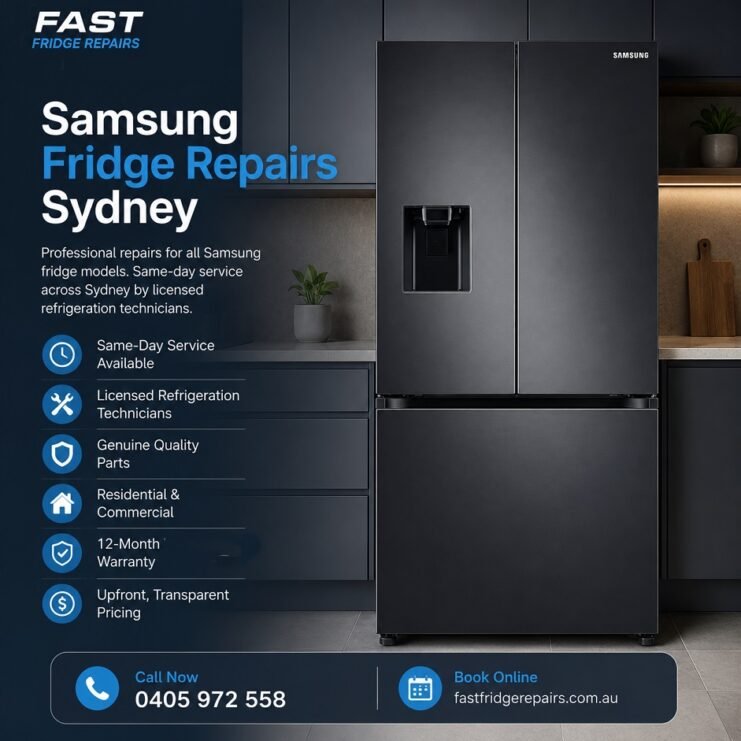
Samsung Fridge Repairs Sydney
Is your Samsung fridge not cooling properly, freezing your salad drawer, leaking water across the kitchen floor or flashing an error code you cannot decode? Fast Fridge Repairs is a family owned team of licensed refrigeration technicians repairing Samsung refrigerators right across Sydney.
- Open 24 Hours & 7 Days
- Same day service
- Residential and commercial repairs
- Call outs Available
- 12-month parts warranty
Samsung Fridge Models We Repair
Samsung French Door and Multi Door Fridges
Samsung's RF series French door models are the brand's flagship domestic product and the most complex to work on. They typically combine Twin Cooling Plus, a digital inverter compressor, multiple sensors, an electronic air damper and, in many cases, a plumbed water and ice system.
Common faults we attend include the fresh food compartment running warm while the freezer stays cold, heavy frost building behind the rear panel, water pooling under the crisper drawers, the ice compartment icing over, and error codes appearing on the door display. Diagnosis starts with reading any stored fault codes, then verifying actual compartment temperatures against the setpoints with our own calibrated probes, then testing each sensor's resistance and each fan's operation individually. Repairs are usually a defrost component, a fan motor, a sensor, a damper assembly or a drain clearance, and the majority are completed on the first visit.
Samsung Side by Side Fridges
The RS series side by side units are popular with larger Sydney households and in shared kitchens because of the tall narrow doors, which suit tight galley layouts. Because both compartments are full height, airflow balance matters more than in other formats.
The faults we see most are the freezer holding temperature while the fridge side drifts warm, ice forming around the dispenser chute, dispenser water stopping, noisy fan operation caused by ice contacting the fan blade, and door seal failure at the top corner where the two doors meet. We test the evaporator fan, the defrost heater and sensor, the water inlet valve where fitted, and the door switches, then repair or replace the failed part.
Samsung Top Mount Fridges
The RT series top mount models are the workhorses of Sydney apartments, rental properties, granny flats and staff kitchens. Mechanically they are the simplest Samsung format, which usually means faster and cheaper repairs.
Typical faults are a failed evaporator fan, a defrost sensor or heater fault causing frost buildup, a temperature sensor drifting out of tolerance, a blocked drain causing water to appear in the crisper, and perished door seals on units over eight years old. These are high value repairs to pursue, because the parts are inexpensive relative to replacing the appliance.
Samsung Bottom Mount Fridges
RB series bottom mount models place the freezer in a pull out drawer at floor level. The most frequent complaints are the freezer drawer not sealing fully, ice accumulating in the drawer, and the fridge compartment above running warmer than its setpoint.
A drawer that will not seal is often mechanical, involving the runner, the drawer basket sitting proud or a distorted gasket, and once the seal is lost, warm humid air enters, condenses, freezes and then progressively blocks airflow. Correcting the seal early prevents a much larger defrost system problem later.
Samsung Quad Door and Four Door Flex Fridges
Four door models add a convertible zone, giving the owner more flexibility and giving the fridge more to go wrong. Alongside the standard refrigeration faults, we frequently test convertible zone dampers and their dedicated sensors, because a zone that will not switch modes or will not hold its selected temperature is nearly always a damper motor, damper flap obstruction or sensor issue rather than a compressor problem.
Samsung Family Hub Fridges
Family Hub units are premium appliances with a large integrated screen. We repair the refrigeration side completely, including compressor, sealed system, fans, sensors, defrost circuit, dampers, drains, seals and control boards. Where a fault is genuinely confined to the screen software or the SmartThings account, we will say so and direct you to Samsung rather than charging for work that will not fix it. That honesty is deliberate, and it is a large part of why customers call us back.
Samsung Bespoke Fridges
Bespoke models are repaired exactly as their standard equivalents. The one point worth knowing is that the interchangeable door panels are cosmetic Samsung supply items, so a damaged panel is a parts order rather than a repair.
Samsung Single Door Fridges and Upright Freezers
Single door fridges and RZ series upright freezers appear constantly in Sydney apartments, offices, garages and small businesses. Faults tend to be thermostat or sensor related, defrost related, or door seal related. Upright freezers are also the units most affected by garage and outdoor laundry installations, where high summer ambient temperatures push the condenser well beyond its design conditions. If you need a broader look at this format, see our upright fridge repairs page.
Samsung Integrated and Built In Fridges
Built in and cabinetry integrated Samsung units require careful removal and refitting, and they run hotter than freestanding fridges because the surrounding joinery restricts airflow to the condenser. Where a built in unit has recurring cooling problems, we check ventilation clearance as part of the diagnosis, because no repair will hold if the condenser cannot reject heat.
Common Samsung Fridge Problems We Repair
Samsung Fridge Not Cooling
Symptoms: Food spoiling faster than usual, the compartment sitting above 5 degrees, the fridge feeling cool rather than cold, or the unit running constantly without getting cold.
Likely causes: A dirty or obstructed condenser coil preventing heat rejection, a failed evaporator fan so cold air is produced but never circulated, a defrost system fault allowing ice to encase the evaporator and block airflow, a temperature sensor reporting incorrect values so the board never calls for cooling, a refrigerant loss in the sealed system, or a compressor or inverter board fault.
Diagnosis: We start by measuring real compartment temperatures rather than trusting the display, then check whether the compressor is running and whether the condenser is warm. A cold evaporator with a warm compartment indicates airflow. A warm evaporator with a running compressor indicates a sealed system or compressor problem. Sensor resistance is tested against specification at known temperature, and fans are tested directly for supply voltage and mechanical operation.
Repair: Depending on findings, this can be a condenser clean, a fan motor replacement, a defrost heater or sensor replacement, a sensor replacement, a control board repair or replacement, or sealed system work.
If ignored: Food safety risk is the immediate concern. Mechanically, a fridge struggling to cool runs its compressor almost continuously, which accelerates wear and can turn an inexpensive airflow repair into a compressor failure.
Samsung Freezer Cold But Fridge Warm
Symptoms: Freezer contents are rock solid while the fridge section is unacceptably warm. This is one of the most common Samsung calls we take.
Likely causes: On Twin Cooling models, a fault confined to the fridge side evaporator, fan or defrost circuit. On single evaporator models, a failed evaporator fan, a jammed or failed air damper, or ice blocking the duct that feeds cold air into the fridge compartment. A fridge side sensor fault can also produce this pattern.
Diagnosis: We remove the rear interior panel to inspect the evaporator and fan directly, look for frost patterns that reveal where airflow stops, check whether the damper opens on command, and test the fridge sensor.
Repair: Fan motor replacement, damper assembly replacement, defrost component replacement, manual defrost and drain clearance, or sensor replacement.
If ignored: The ice mass grows, airflow reduces further, and the compressor runs longer to compensate. Left long enough, the drain also blocks and water begins to appear inside the fridge.
Samsung Fridge Freezing Food
Symptoms: Lettuce and other produce freezing in the crisper, milk developing ice crystals, or items at the back of the shelf frozen solid while items at the front are fine.
Likely causes: A temperature sensor reading warmer than reality so the board overcools, an air damper stuck open, an incorrect setpoint, or items placed directly in the path of the cold air outlet.
Diagnosis: Setpoints are verified first, then sensor resistance is compared against specification, then damper position and operation are checked.
Repair: Sensor replacement, damper repair or replacement, or board replacement where the control output is at fault.
If ignored: Mostly a food waste and energy cost problem, though sustained overcooling means unnecessary compressor runtime.
Samsung Fridge Temperature Fluctuating
Symptoms: Temperature that swings noticeably through the day, or an alarm and error code appearing intermittently.
Likely causes: Sensor drift, a marginal door seal, a partially blocked condenser, a fan operating intermittently, a failing damper, or a control board with an unstable output.
Diagnosis: Because the fault is intermittent, we log temperature behaviour over a full cycle rather than taking a single reading, then test the components implicated by the pattern.
Repair: Whichever component is confirmed faulty. Fluctuation is the fault type most often misdiagnosed by guesswork, which is why measurement matters here more than anywhere else.
Samsung Fridge Leaking Water
Symptoms: Water under the crisper drawers, water pooling on the floor, or ice forming in a sheet on the floor of the fridge or freezer.
Likely causes: A blocked or frozen defrost drain line, a cracked or displaced drain pan, a worn door gasket allowing humid Sydney air in to condense, a water inlet valve or supply line fault on plumbed models, or a fridge sitting out of level so meltwater runs the wrong way.
Diagnosis: We trace where the water originates rather than where it collects, inspect and flush the drain, check gasket seal along the full perimeter, and pressure check plumbed connections where fitted.
Repair: Drain clearance and reprofiling, drain heater or clip replacement where fitted, gasket replacement, valve or line replacement, or levelling.
If ignored: Water damage to flooring and cabinetry, mould, and in the case of a frozen drain, progressive ice buildup that eventually blocks airflow.
Samsung Fridge Making Noise
Symptoms: Rattling, buzzing, clicking, grinding, or a loud continuous hum.
Likely causes: Ice contacting a fan blade, worn fan motor bearings, a loose condenser fan mount, tubing vibrating against the cabinet, a failing inverter compressor, or a start relay fault on older non inverter units.
Diagnosis: Noise diagnosis is largely about isolation. We identify whether the noise tracks the compressor, the evaporator fan or the condenser fan by observing when it starts and stops, then confirm mechanically.
Repair: Ice removal and defrost repair, fan motor replacement, remounting or isolation of vibrating components, relay replacement, or compressor work.
If ignored: A clicking compressor that will not start is often a relay or inverter board fault at that point. Repeated failed start attempts can damage the compressor windings, converting a modest repair into a major one.
Samsung Fridge Running Constantly
Symptoms: The compressor never seems to stop, and the power bill has climbed.
Likely causes: A condenser coil coated in dust and pet hair, a condenser fan not running, poor ventilation clearance, a failing door seal, ice restricting airflow, a sensor misreporting temperature, or low refrigerant charge.
Diagnosis: Condenser condition and fan operation are checked first because they are the most common and cheapest to correct, then seals, then sensors, then system performance.
Repair: Condenser clean, fan replacement, seal replacement, defrost repair, sensor replacement, or sealed system work.
If ignored: Continuous running is the single best predictor of a future compressor failure. It is also the fault most worth catching early, because the fix is frequently inexpensive.
Samsung Fridge Not Turning On
Symptoms: No lights, no fan, no compressor, or a display that is lit while nothing else operates.
Likely causes: Power supply or outlet fault, a fault in the fridge's power board, a main control board failure, a wiring harness fault, or the unit sitting in a demonstration or cooling off mode.
Diagnosis: Supply is confirmed at the outlet first, then at the appliance, then the boards and harness are tested. We also confirm the unit is not simply in showroom or cooling off mode, which is a genuinely common and completely free fix.
Repair: Board repair or replacement, harness repair, or mode correction.
Samsung Fridge Door Seal Problems
Symptoms: A door that does not pull itself shut, visible gaps, condensation around the door frame, frost near the hinge, or a door alarm sounding intermittently.
Likely causes: A perished, compressed or torn gasket, distortion from a heavily loaded door bin, hinge wear, or a fridge out of level.
Diagnosis: The paper test along the full door perimeter, closing the door on a sheet of paper and checking the resistance when pulling it out. Weak resistance anywhere means air is entering there.
Repair: Gasket replacement, hinge adjustment or replacement, levelling.
If ignored: Humid air entering continuously means frost buildup, longer compressor runtime, higher bills and eventually a defrost system problem.
Samsung Fridge Defrost Problems
Symptoms: Thick frost on the rear interior panel, frost on the metal cooling panel, reduced cooling that improves temporarily after you manually defrost the unit, or water appearing after a period of frost.
Likely causes: A failed defrost heater, a failed defrost sensor or thermal fuse, a control board no longer initiating the defrost cycle, or a blocked drain so meltwater refreezes rather than draining away.
Diagnosis: The defrost heater is tested for continuity and correct resistance, the defrost sensor is tested against specification, and the board's defrost output is checked. Frost distribution across the evaporator itself tells an experienced technician a great deal before any meter comes out.
Repair: Heater replacement, sensor or fuse replacement, drain clearance, or board replacement.
If ignored: Defrost faults are progressive by nature. Every cycle adds ice, and each addition further restricts airflow, so a unit that is slightly warm today will fail to cool entirely within weeks.
Samsung Fridge Communication Errors
Symptoms: An error code indicating a communication or panel fault, a display that freezes or goes blank, or controls that will not respond while the fridge continues to cool.
Likely causes: A damaged or chafed wiring harness between the main board and the display board, a connector that has worked loose or corroded, a failed display board, or a failed main board.
Diagnosis: Continuity and connector integrity are checked along the harness, particularly at the door hinge where flexing wears insulation over years of use. Boards are only condemned once the wiring is proven sound.
Repair: Harness repair or replacement, connector reseating or replacement, or board replacement.
If ignored: Communication faults can prevent the board from receiving accurate temperature data, which risks food safety even when the compressor appears to be running normally.
Samsung Fridge Control Board and PCB Failures
Symptoms: Multiple unrelated symptoms at once, components that will not switch on despite testing good, repeated unexplained error codes, or a fridge that behaves erratically after a storm or power interruption.
Likely causes: Power surge damage, heat stress on components, moisture ingress, capacitor degradation over time, or relay contact failure on the board.
Diagnosis: Board diagnosis is a process of elimination. Each output is checked for correct voltage under load, and each connected component is verified independently, so a board is only replaced once the fault is proven to be on the board rather than downstream of it.
Repair: Board replacement, or in some cases replacement of a specific failed component on the board.
If ignored: An unstable board can drive other components incorrectly, and can allow the compartment to sit at unsafe temperatures without triggering any alarm.
Samsung Fridge Compressor Problems
Symptoms: No cooling at all, a compressor that hums then falls silent, a compressor that clicks repeatedly, or a compressor that is hot to the touch and not pumping.
Likely causes: On inverter models, an inverter control board fault, a winding fault or a mechanical failure. On older conventional models, a failed start relay or run capacitor, or worn internal components after many years of service.
Diagnosis: Winding resistance is measured, supply to the compressor is verified, and on inverter models the drive board output is checked, because a healthy compressor with no drive signal presents identically to a dead compressor to anyone who does not test properly. Where the compressor is confirmed faulty, we check whether your Samsung compressor parts warranty is still current before quoting.
Repair: Relay or capacitor replacement, inverter board replacement, or compressor replacement with the correct evacuation, drier replacement and recharge.
If ignored: A compressor drawing current without pumping wastes energy and can develop into an electrical fault.
Samsung Fridge Fan Motor Failures
Symptoms: Uneven cooling, a warm fridge with a cold freezer, noise, or no audible airflow when the door is opened and the switch is defeated.
Likely causes: Bearing wear, ice damage to the blade or motor, a broken wire at the connector, or a control board no longer supplying the fan.
Diagnosis: Supply voltage at the fan is confirmed, then the motor is tested. Both the evaporator fan and the condenser fan are checked, since a failed condenser fan mimics several other faults.
Repair: Fan motor and blade assembly replacement, and correction of any ice source that damaged it.
Samsung Fridge Sensor Faults
Symptoms: An error code, a compartment that is too warm or too cold, or a display temperature that does not match reality.
Likely causes: Thermistor drift over years of thermal cycling, moisture damage at the sensor body, or a broken wire.
Diagnosis: Each thermistor is measured for resistance at a known temperature and compared against the manufacturer's curve for that model. Sensors are inexpensive, which is precisely why they should be measured rather than replaced speculatively.
Repair: Sensor replacement and verification that compartment temperature now tracks the setpoint.
Samsung Fridge Error Codes Explained
Samsung refrigerators run a self diagnostic routine and display a code when a fault is detected. Codes are model and generation specific, and the same characters can mean different things on different platforms, so treat the table below as a guide to the general fault area rather than an exact instruction for your unit. Give us your model number when you call and we will confirm the meaning for your specific fridge.
| Code | General Meaning | Likely Cause | Typical Repair |
|---|---|---|---|
| 1 E / 5 E | Fridge compartment sensor fault | Thermistor drift, moisture damage or broken wire | Sensor replacement |
| 2 E | Freezer compartment sensor fault | Thermistor or wiring fault | Sensor replacement |
| 4 E / 5 E | Defrost sensor fault | Failed defrost thermistor or open circuit | Defrost sensor replacement |
| 6 E | Ambient or external temperature sensor fault | Sensor or wiring failure | Sensor replacement |
| 21 E | Freezer fan fault | Fan motor failure, ice obstruction or lost supply | Fan replacement, defrost repair |
| 22 E | Fridge fan fault | Fan motor failure or ice obstruction | Fan replacement, defrost repair |
| 23 E | Condenser fan fault | Fan motor failure, debris obstruction or lost supply | Condenser fan replacement |
| 24 E / 25 E | Defrost cycle failure | Defrost heater, sensor, fuse or board output fault | Defrost component replacement |
| 26 E | Water valve or ice compartment fault | Water inlet valve, wiring, or ice restriction | Valve or wiring repair, defrost repair |
| 39 E / 40 E | Ice compartment function or fan fault | Ice buildup, fan or sensor fault in that compartment | Defrost repair, fan or sensor replacement |
| 41 E / 42 E / 43 E | Main board or panel communication fault | Harness damage, loose connector, board failure | Harness repair or board replacement |
| 83 E / 85 E / 86 E | Power or inverter board fault | Surge damage, inverter drive failure | Inverter or power board replacement |
| PC ER | Panel to main board communication fault | Harness or connector fault at the door hinge, board failure | Harness repair or board replacement |
| 88 88 / 8 8 | Power reset or self diagnostic display state | Power interruption, or a fault requiring diagnosis | Power cycle, then diagnose if it returns |
| OF OF / O FF | Cooling off, demonstration or showroom mode | Mode activated intentionally or by accident | Exit the mode using the model's button sequence |
| dE / dU | Door open or door alignment fault | Door not closing, switch fault, gasket or hinge fault | Switch, hinge or gasket repair |
Two practical points. First, OF OF and 88 88 are not necessarily faults at all, and a fridge that appears dead is sometimes simply in cooling off mode. Try a power cycle at the wall for a few minutes before assuming the worst. Second, a code that clears on a power cycle and then returns is telling you there is a hardware fault. Clearing it repeatedly does not fix anything and delays a repair that will only get more expensive.
Why These Problems Occur
Understanding the cause of refrigeration failure helps you avoid repeating it.
- Heat: A fridge does not create cold, it moves heat out of the cabinet and rejects it through the condenser. Anything reducing that rejection reduces cooling. Sydney summers, kitchens without ventilation, garages, enclosed cabinetry and fridges pushed hard against a wall all raise condensing temperature and force the system to work harder for the same result.
- Dirty condenser: Dust, lint and pet hair form an insulating blanket over the condenser coil. The compressor then runs longer and hotter to achieve the same temperature. This single issue is behind a very large share of the "not cooling" and "running constantly" calls we attend, and it is entirely preventable.
- Airflow restriction: Cold air must circulate. Overpacked shelves, items blocking the rear air outlets, and ice buildup on the evaporator all interrupt that circulation. Cooling failures caused by airflow are extremely common and often mistaken for compressor failure.
- Moisture: Every door opening admits humid air, which condenses on the coldest surface and freezes. That is normal, which is why fridges defrost periodically. It becomes a problem when the defrost circuit fails or the drain blocks, because then the ice accumulates instead of leaving.
- Door openings and seals: A weak gasket is effectively a door left slightly open all day. It admits humid air continuously, drives frost buildup, raises energy consumption and shortens compressor life.
- Blocked drain: Meltwater has to leave the cabinet. When the drain blocks with debris or freezes, water either pools inside, leaks onto your floor, or refreezes into a growing ice mass.
- Power surges: Storm activity and grid disturbances damage electronics. Modern Samsung fridges depend on a main board, a display board and often an inverter board, all of which are surge vulnerable. This is why board failures often appear immediately after a storm or a blackout.
- Sensor drift: Thermistors change resistance characteristics slowly over years of thermal cycling. A drifted sensor does not fail outright, it simply lies to the control board, which then makes the wrong decisions. This is why a fridge can be freezing food or running warm with no other component at fault.
- Electrical wear: Relays have finite switching lives, capacitors degrade, and harnesses chafe where they flex, particularly at door hinges. These are ordinary ageing processes rather than defects.
- Compressor ageing: Compressors wear internally over many years. Efficiency falls before failure occurs, which is why an older fridge often runs noticeably longer for the same result in the year before it stops.
- Poor maintenance: None of the above is exotic. Most refrigeration failures we attend were preventable, or at least detectable early, with basic attention to coils, seals, airflow and drains.
Our Samsung Fridge Diagnostic Process
We use a systematic 11-step diagnostic workflow to locate the precise cause of the failure before fitting any replacement components:
Samsung Fridge Components We Commonly Repair and Replace
Our mobile service vans carry stock for a wide array of original specification Samsung refrigeration components, including:
- Compressor
- Condenser
- Condenser fan
- Evaporator
- Evaporator fan
- Refrigerant & sealed system
- Filter drier
- Capillary tube
- Expansion valve
- Thermistors & sensors
- PCB & main control board
- Display & panel board
- Start relay & run capacitor
- Defrost heater
- Defrost sensor & thermal fuse
- Defrost timer & board control
- Air damper
- Drain line & drain heater
- Door gasket
Preventative Maintenance for Samsung Refrigerators
- Clean the condenser every six to twelve months: Remove dust, lint, and pet hair to ensure proper heat dissipation.
- Test your door seals monthly: Perform the paper test along the perimeter to check for cold air leaks.
- Leave ventilation clearance: Ensure adequate breathing space around the sides, rear, and top of the unit.
- Do not overload, and keep air outlets clear: Avoid blocking internal airflow vents with food packages.
- Set the correct temperatures: Maintain ~3°C for the fridge compartment and ~-18°C for the freezer.
- Keep the drain clear: Check that meltwater drains freely to prevent floor pooling or internal freezing.
- Level the appliance: Ensure the fridge sits level so doors seal properly and drain water flows correctly.
- Have it serviced when performance changes: Address minor noises or temperature changes early.
Why Sydney Homes and Businesses Choose Fast Fridge Repairs
Refrigeration is What We Do
We are not general appliance repairers who also attend fridges. Our technicians are licensed refrigeration specialists, and that shows most clearly in diagnosis, which is where the money is either saved or wasted on a Samsung repair.
We Measure Rather Than Guess
Samsung fridges present several very different faults with almost identical symptoms. We test sensors, fans, boards, defrost circuits and system performance to identify the actual failure, so you pay for the repair you need rather than a sequence of replaced parts.
Residential & Commercial Capability
We work in Sydney homes, apartments and townhouses, and in restaurants, cafés, offices, medical centres and retail. Both environments have Samsung units, and both are covered.
Well Stocked Service Vehicles
Fan motors, sensors, gaskets, defrost components, relays and control components travel with our technicians, which is the practical reason most repairs finish on the first visit.
Quality Parts & 12-Month Warranty
We fit correct specification parts and stand behind them for 12 months on parts.
Clear Pricing Explained Up Front
Our call out fee starts from $69, and you will be told the cost of the repair before it begins. Depending on the job, that quote may be verbal on site or provided in writing.
Licensed, Insured & Locally Based
$10 million public liability cover, and a Colebee base in north west Sydney that lets us reach the whole metropolitan area efficiently.
Family Owned & Open 24 Hours
You reach our team, not an offshore call centre. We hold a 4.9 star rating from more than 300 Google reviews, and we are conscious that this reputation is the reason most of our work arrives. If your Samsung fridge is not worth repairing, we will tell you honestly.
Samsung Fridge Repairs Near You Across Sydney
We repair Samsung refrigerators wherever they are installed. In houses, apartments and townhouses across the Eastern Suburbs and Inner West, where narrow access and shared lift arrangements are part of the job. In family homes throughout Western Sydney, Blacktown, Penrith and the Hills District. In North Shore and Northern Beaches properties, including built in and integrated installations. In restaurant and café kitchens, where a Samsung unit is often holding prep stock alongside dedicated commercial refrigeration. In medical centres and allied health practices with temperature sensitive storage. In offices, staff kitchens and serviced apartments where a fridge failure disrupts a whole floor.
Our technicians work across Sydney CBD, Parramatta, Blacktown, Penrith, Castle Hill, Hills District, Ryde, Chatswood, Liverpool, Campbelltown, Bondi, the Eastern Suburbs, the Inner West, the North Shore, the Northern Beaches, St George, and Canterbury Bankstown.
Check the full list of suburbs on our areas we serve page, or simply call and tell us where you are.
Frequently Asked Questions
Is it worth repairing a Samsung fridge?
In most cases yes, particularly if the fridge is under 10 years old and the fault is a single component such as a fan motor, sensor, defrost heater, damper or door seal. Those repairs typically cost a fraction of a replacement appliance. Repair becomes questionable when a unit over 15 years old needs compressor or sealed system work, or when several major faults occur together. If your Samsung compressor is still within its parts warranty, that can change the calculation significantly, so it is always worth checking before deciding.
What is the most common problem with Samsung refrigerators?
The problems most commonly reported by Samsung owners are ice related faults in the ice compartment and severe frost or ice buildup that eventually stops the fridge cooling properly. On the units we attend, that ice buildup almost always traces back to the defrost circuit, a failed defrost heater or sensor, or a blocked drain, and once ice encases the evaporator, airflow stops and the whole cabinet loses cooling. We repair those refrigeration faults, including frost buildup affecting the ice compartment. We do not repair standalone ice machines or standalone ice makers.
Is there a reset button on a Samsung fridge?
Most Samsung refrigerators do not have a dedicated reset button. The usual reset is to unplug the fridge at the wall, wait a few minutes and reconnect it, which clears transient display states such as a power reset indication.
Book Your Samsung Fridge Repair in Sydney
Fast Fridge Repairs repairs Samsung fridges, fridge freezers and freezers across the Sydney metropolitan area, covering cooling faults, defrost and frost problems, water leaks, noise, fan and sensor failures, control board and communication errors, door seal issues and compressor faults, for both homes and businesses. We do not repair standalone ice machines or standalone ice makers.
Refrigeration faults do not stay still. A fan motor that has started to fail, a gasket that no longer seals or a defrost circuit that has stopped triggering will all keep pushing the compressor harder until the cheap repair becomes an expensive one. Getting an accurate diagnosis early is genuinely the difference between a modest bill and a new fridge.