


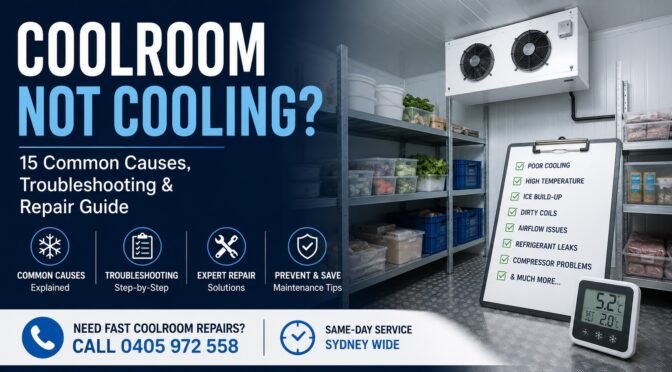
A commercial coolroom that isn’t maintaining the correct temperature can quickly become a costly problem. Whether you operate a restaurant, cafe, supermarket, butcher shop, florist, pharmacy or commercial kitchen, inadequate cooling can lead to food spoilage, stock loss, HACCP compliance issues and expensive business downtime.
If your coolroom is running but not getting cold, don’t assume the compressor has failed. Poor cooling can be caused by dozens of different issues, including dirty condenser coils, refrigerant leaks, faulty evaporator fans, damaged door seals, blocked airflow, thermostat problems or electrical faults. Some issues are relatively minor and inexpensive to fix, while others require specialist refrigeration diagnosis.
This guide explains the most common reasons a commercial coolroom loses cooling performance, how refrigeration systems work, what you can safely check yourself, and when it’s time to call a licensed refrigeration technician.
If you’re looking for coolroom repairs near you, commercial refrigeration repair near you, or emergency fridge repairs in Sydney, understanding the cause of the problem can help minimise downtime and prevent more expensive damage.
Quick Answer
A coolroom that isn’t cooling properly is usually suffering from restricted airflow, dirty condenser coils, low refrigerant, a faulty evaporator fan, compressor problems, thermostat issues or a damaged door seal. Less common causes include electrical faults, failed control boards and expansion valve problems. Accurate diagnosis is essential because several different faults can produce similar symptoms. Professional refrigeration technicians use temperature testing, electrical diagnostics and refrigeration pressure testing to identify the exact cause before carrying out repairs.
Why Proper Coolroom Temperature Matters
Commercial coolrooms do much more than keep products cold. They help maintain food safety, preserve product quality and ensure businesses comply with Australian food storage regulations.
Even a small increase in temperature can have serious consequences.
Poor cooling may result in:
- Food spoilage
- Reduced shelf life
- Bacterial growth
- Lost stock
- Higher electricity bills
- Increased compressor wear
- HACCP compliance issues
- Business interruptions
- Customer complaints
- Expensive emergency repairs
For businesses storing pharmaceuticals, dairy products, meat, seafood or fresh produce, temperature stability is critical. Allowing temperatures to fluctuate for extended periods can compromise product quality and create health risks.
How Does a Commercial Coolroom Work?
Understanding how a coolroom works makes it much easier to understand why cooling problems occur.
A commercial coolroom operates by continuously removing heat from inside the room and transferring it outside through a refrigeration cycle.
The main components include:
Compressor
The compressor is the heart of the refrigeration system. It circulates refrigerant throughout the system by increasing its pressure and temperature.
If the compressor cannot operate correctly, the coolroom will struggle to remove heat efficiently.
Condenser
The condenser releases heat collected from inside the coolroom into the surrounding air.
Dirty condenser coils or restricted airflow prevent heat from escaping, reducing overall cooling performance.
Expansion Valve
The expansion valve carefully controls the amount of refrigerant entering the evaporator coil.
Incorrect refrigerant flow can cause poor cooling, icing problems or unstable temperatures.
Evaporator Coil
Located inside the coolroom, the evaporator absorbs heat from the room as refrigerant evaporates inside the coil.
Cold air is then distributed throughout the room by the evaporator fan.
Evaporator Fan Motor
The fan circulates cold air evenly around the coolroom.
If airflow is reduced, products closest to the evaporator may remain cold while other areas become too warm.
Temperature Controller
Digital controllers monitor the coolroom temperature and switch the refrigeration system on and off as required.
Faulty sensors or controllers may allow temperatures to rise without triggering the cooling system correctly.
Refrigerant
Refrigerant is the working fluid that transfers heat throughout the refrigeration cycle.
Low refrigerant levels caused by leaks significantly reduce cooling capacity and increase compressor workload.
Signs Your Coolroom Isn’t Cooling Properly
Many businesses don’t notice cooling problems until stock begins spoiling.
Recognising the early warning signs can prevent major breakdowns.
Common symptoms include:
Temperature Higher Than Set Point
The coolroom struggles to reach the desired temperature even though the refrigeration system appears to be operating normally.
Compressor Running Constantly
Continuous compressor operation often indicates the system is working harder than necessary due to airflow restrictions, refrigerant loss or mechanical faults.
Warm Areas Inside the Coolroom
Some products remain cold while others become noticeably warmer.
Uneven temperatures usually point to airflow problems, evaporator fan faults or blocked evaporator coils.
Food or Stock Spoiling Earlier
Perishable products begin deteriorating sooner than expected despite being stored inside the coolroom.
Ice Build-Up
Heavy ice accumulation around the evaporator coil can block airflow and significantly reduce cooling efficiency.
Condensation
Water droplets forming inside the coolroom, excessive humidity or sweating around doors often indicate warm air entering the room.
Higher Electricity Bills
A refrigeration system that runs longer due to poor efficiency consumes more electricity.
Increasing energy costs are often one of the earliest indicators of cooling problems.
Digital Controller Alarms
Many modern coolrooms display warning messages or temperature alarms when cooling performance declines.
Never ignore these alerts, as they often indicate developing faults before complete system failure occurs.
Also Read:
Why Freezers Stop Working in Cold Garages & Outdoor Areas
15 Common Causes of Inadequate Coolroom Cooling
Although every refrigeration system is different, most cooling problems fall into a handful of common categories.
Professional diagnosis is important because several faults can produce almost identical symptoms.
1. Dirty Condenser Coils
One of the most common causes of poor coolroom performance is dirty condenser coils.
The condenser is responsible for releasing heat collected from inside the coolroom. When dust, grease or debris coats the coils, heat cannot escape efficiently.
As a result:
- Cooling performance declines
- Compressor run times increase
- Electricity consumption rises
- Components wear faster
- High-pressure faults may develop
Businesses such as restaurants, bakeries and commercial kitchens often experience this issue because airborne grease rapidly contaminates condenser coils.
Regular professional cleaning is one of the simplest ways to improve cooling efficiency and extend equipment life.
2. Refrigerant Leaks
Low refrigerant is another leading cause of inadequate cooling.
Contrary to popular belief, refrigerant isn’t “used up” during normal operation. If refrigerant levels are low, there is almost always a leak somewhere within the sealed refrigeration system.
Signs include:
- Coolroom not reaching temperature
- Compressor running continuously
- Ice forming unevenly
- Reduced cooling capacity
- Higher operating costs
Refrigerant leaks should always be diagnosed and repaired by licensed refrigeration technicians, who can locate the leak, repair the faulty section and recharge the system to the manufacturer’s specifications.
3. Faulty Evaporator Fan Motor
The evaporator fan distributes cold air evenly throughout the coolroom.
If the fan slows down, stops completely or becomes obstructed, cold air cannot circulate properly.
Typical symptoms include:
- Warm spots throughout the room
- Uneven temperatures
- Ice build-up on the evaporator
- Products near the door becoming warm
- Compressor running longer than normal
Because proper airflow is essential for efficient refrigeration, even a partially failing fan motor can significantly reduce overall cooling performance.
4. Blocked Airflow Inside the Coolroom
Not every cooling problem is caused by faulty refrigeration components.
Improper product storage can also restrict airflow.
Common causes include:
- Boxes stacked against evaporator units
- Overstocked shelving
- Blocked return air vents
- Products stored too close to cooling outlets
Without adequate air circulation, the refrigeration system cannot distribute cold air evenly, resulting in temperature differences throughout the coolroom.
Proper shelving layouts and stock management play an important role in maintaining consistent temperatures.
5. Compressor Problems
The compressor is the heart of every commercial refrigeration system. Its job is to circulate refrigerant through the sealed system, allowing heat to be removed from inside the coolroom. If the compressor cannot operate efficiently, cooling performance quickly declines.
Unlike dirty condenser coils or blocked airflow, compressor problems usually become progressively worse over time. Ignoring the warning signs can eventually lead to complete refrigeration failure and costly replacement.
Common symptoms include:
- Coolroom not reaching the set temperature
- Compressor running continuously
- Loud humming or knocking noises
- Frequent short cycling
- Overheating
- Tripped circuit breakers
- High electricity consumption
- Complete loss of cooling
Compressor issues may be caused by worn internal components, faulty start relays, failed capacitors, electrical supply problems, refrigerant issues or excessive operating pressures.
Because compressor replacement is one of the most expensive refrigeration repairs, professional diagnosis is essential before assuming the compressor has failed. In many cases, another component may be preventing the compressor from operating correctly.
6. Faulty Thermostat or Temperature Controller
Modern commercial coolrooms rely on electronic thermostats or digital temperature controllers to maintain precise storage temperatures.
These controllers monitor internal temperatures and signal the refrigeration system to start or stop as required.
If the thermostat or controller becomes inaccurate, the coolroom may:
- Become too warm
- Become too cold
- Cycle on and off incorrectly
- Display incorrect temperatures
- Trigger alarm codes
- Run continuously
Temperature control issues are particularly common in older coolrooms where sensors gradually drift out of calibration.
Professional testing confirms whether the problem lies with the controller, sensor or another refrigeration component.
7. Defective Temperature Probe
Temperature probes (also known as thermistors or temperature sensors) continuously monitor air temperature inside the coolroom.
If the probe sends incorrect information to the controller, the refrigeration system makes incorrect decisions.
Typical symptoms include:
- Temperature fluctuations
- Incorrect controller readings
- Compressor short cycling
- Food temperatures varying throughout the day
- Random alarm messages
Because sensor faults often appear intermittent, they are frequently misdiagnosed without proper electrical testing.
8. Damaged Door Seals
Every time warm outside air enters a coolroom, the refrigeration system must remove that additional heat.
One of the biggest contributors to inadequate cooling is damaged or worn door gaskets.
Signs include:
- Condensation around the doorway
- Frost around the frame
- Doors not sealing properly
- Compressor running more frequently
- Increased humidity
- Higher energy bills
Even a small gap allows warm, moist air to enter continuously.
Over time this causes:
- Ice formation
- Poor temperature stability
- Excessive compressor wear
- Higher operating costs
Replacing worn door seals is often one of the most cost-effective refrigeration repairs.
9. Ice Build-Up on the Evaporator Coil
The evaporator removes heat from inside the coolroom.
When excessive ice forms around the evaporator, airflow becomes restricted.
Eventually the coolroom may stop cooling even though every major refrigeration component is still operating.
Heavy ice build-up commonly results from:
- Defrost system failures
- Faulty heaters
- Failed defaporator sensors
- Damaged door seals
- High humidity
- Doors left open
Many business owners mistakenly believe more ice means better cooling.
In reality, excessive ice acts like insulation, preventing heat transfer and reducing cooling efficiency.
10. Defrost System Failure
Commercial coolrooms automatically remove frost from the evaporator using a programmed defrost cycle.
If the defrost system stops working correctly, frost gradually accumulates until airflow becomes severely restricted.
Components that commonly fail include:
- Defrost heaters
- Defrost timers
- Defrost sensors
- Defrost termination thermostats
- Electronic controllers
Typical symptoms include:
- Large ice build-up
- Warm products
- Reduced airflow
- Long compressor run times
- Temperature alarms
Professional diagnosis identifies which component within the defrost system has failed.
11. Condenser Fan Failure
The condenser fan removes heat from the refrigeration system.
If airflow across the condenser decreases, operating pressures rise dramatically.
Common symptoms include:
- Poor cooling
- Compressor overheating
- High pressure safety trips
- Loud fan noise
- Increased electricity consumption
Restaurants and commercial kitchens often experience this problem because grease and dust contaminate fan motors over time.
12. Expansion Valve Problems
The expansion valve controls refrigerant flow into the evaporator.
If too much or too little refrigerant enters the evaporator, cooling efficiency drops significantly.
Expansion valve faults may produce:
- Poor cooling
- Ice formation
- Flooding
- Starved evaporators
- Temperature instability
Diagnosis requires specialist refrigeration testing including pressure readings, superheat measurements and system performance analysis.
13. Electrical Problems
Commercial refrigeration systems rely on numerous electrical components working together.
A single electrical fault may prevent the refrigeration system from operating correctly.
Common electrical faults include:
- Loose wiring
- Burnt terminals
- Failed contactors
- Blown fuses
- Faulty overloads
- Damaged circuit breakers
- Voltage supply issues
Electrical faults should always be investigated by qualified technicians due to the safety risks involved.
14. Control Board Failure
Modern commercial coolrooms increasingly use electronic control boards to manage refrigeration cycles.
When a PCB begins failing, symptoms may include:
- Random shutdowns
- Incorrect temperatures
- Fan failures
- Compressor problems
- Alarm codes
- Intermittent cooling
Because PCB faults often mimic other refrigeration problems, replacing the board without proper testing can become an expensive mistake.
15. Poor Preventative Maintenance
One of the biggest causes of inadequate cooling isn’t component failure—it’s a lack of regular maintenance.
Without scheduled servicing, small issues gradually become major breakdowns.
Routine commercial refrigeration maintenance helps identify problems before they interrupt your business.
A preventative maintenance program typically includes:
- Cleaning condenser coils
- Inspecting evaporator coils
- Checking refrigerant pressures
- Testing compressors
- Inspecting fan motors
- Checking electrical connections
- Calibrating temperature controllers
- Testing defrost systems
- Inspecting door seals
- Verifying operating temperatures
For businesses that rely on refrigeration every day, preventative servicing is usually far less expensive than emergency repairs and stock losses.
Also Read:
Why Is My Fridge Running Constantly? Causes & Fix
Can You Troubleshoot a Coolroom Yourself?
Some cooling problems can be identified through basic visual checks before calling a refrigeration technician.
Safe checks include:
- Confirm the controller is set to the correct temperature.
- Check whether the condenser coils are visibly dirty.
- Make sure products aren’t blocking evaporator airflow.
- Ensure the coolroom door closes fully.
- Inspect door gaskets for visible damage.
- Listen for unusual fan or compressor noises.
- Check whether any alarm codes are displayed.
- Confirm the power supply hasn’t tripped.
These simple inspections may identify obvious issues without requiring specialist equipment.
However, avoid attempting repairs involving refrigerant, electrical systems or refrigeration components unless you are appropriately qualified. Commercial refrigeration systems operate under high pressure and contain electrical components that require specialist knowledge and licensing.
When Should You Call a Refrigeration Technician?
While routine cleaning and visual inspections can help maintain your coolroom, certain symptoms require professional attention as soon as possible.
Arrange professional repairs if you notice:
- The coolroom won’t reach the correct temperature.
- The compressor runs constantly.
- Refrigerant leaks are suspected.
- Ice continues building up after defrosting.
- Electrical breakers continue tripping.
- Temperature alarms persist.
- Products are beginning to spoil.
- The refrigeration system has stopped completely.
Prompt repairs can often prevent minor faults from developing into compressor failures or complete system breakdowns, helping protect both your stock and your business operations.
Businesses Most Affected by Coolroom Cooling Problems
Commercial coolrooms are used across a wide range of industries where maintaining a consistent temperature is essential for product quality, food safety and regulatory compliance. Even a small increase in temperature can lead to significant financial losses, wasted stock and interrupted operations.
At Fast Fridge Repairs, we repair commercial coolrooms for businesses throughout Sydney, helping minimise downtime and restore reliable refrigeration as quickly as possible.
Restaurants
Restaurants depend on coolrooms to safely store meat, seafood, dairy products, sauces, fresh produce and prepared ingredients. If a coolroom begins running above the recommended temperature, food quality can deteriorate rapidly, increasing the risk of spoilage and food safety breaches.
Common restaurant issues include:
- Warm coolrooms during busy service periods
- Dirty condenser coils caused by kitchen grease
- Evaporator icing
- Door seals damaged through frequent use
- Overloaded shelving restricting airflow
Cafes & Coffee Shops
Most cafes operate with limited refrigeration space, meaning even a short breakdown can disrupt daily operations.
Cooling problems commonly affect:
- Milk storage
- Sandwich ingredients
- Cakes and desserts
- Fresh juices
- Cold beverages
- Prepared food
Regular maintenance helps reduce unexpected breakdowns during busy trading hours.
Supermarkets & Grocery Stores
Retail businesses rely heavily on commercial refrigeration to preserve fresh produce, dairy products, beverages and packaged foods.
Cooling failures may result in:
- Product spoilage
- Customer complaints
- Insurance claims
- Revenue loss
- Food safety concerns
Because supermarket refrigeration often operates continuously, preventative maintenance is particularly important.
Butchers & Seafood Suppliers
Fresh meat and seafood require strict temperature control to maintain food safety.
Even minor cooling failures may result in:
- Stock contamination
- Reduced shelf life
- HACCP compliance issues
- Significant financial losses
Bakeries
Commercial bakeries frequently use coolrooms to store creams, fillings, pastries and perishable ingredients.
High ambient temperatures inside bakeries place additional strain on refrigeration equipment, making routine servicing essential.
Florists
Flowers remain fresher for much longer when stored at carefully controlled temperatures.
Poor cooling may reduce flower quality, shorten shelf life and increase product waste.
Medical Centres & Pharmacies
Medical refrigeration often stores vaccines, medicines and temperature-sensitive products.
Reliable temperature control is critical for maintaining product effectiveness and complying with healthcare storage requirements.
Hotels, Clubs & Pubs
Hospitality venues often operate multiple refrigeration systems simultaneously.
Cooling failures can affect:
- Beverage storage
- Food preparation
- Function rooms
- Commercial kitchens
- Bars
Fast repairs help minimise business disruption and stock losses.
Commercial Kitchens
Commercial kitchens place heavy demands on refrigeration systems due to constant door openings, high ambient temperatures and continuous operation.
Routine servicing helps maintain consistent cooling performance during peak periods.
The Hidden Cost of Poor Coolroom Cooling
Many business owners focus only on repair costs without considering the much larger financial impact of inadequate cooling.
A coolroom operating only a few degrees above its target temperature may continue running, but it becomes significantly less efficient.
This can result in:
- Increased electricity consumption
- Shortened compressor lifespan
- More frequent breakdowns
- Food spoilage
- Lost revenue
- Emergency repair costs
- Staff downtime
- Customer dissatisfaction
Addressing small refrigeration issues early is almost always more cost-effective than waiting for complete system failure.
How to Prevent Coolroom Cooling Problems
Many refrigeration breakdowns are preventable through routine maintenance and good operating practices.
Implementing a preventative maintenance program helps improve reliability, reduce running costs and extend the lifespan of commercial refrigeration equipment.
Clean Condenser Coils Regularly
Dirty condenser coils are one of the leading causes of inadequate cooling.
Cleaning the coils improves heat transfer, reduces compressor workload and lowers electricity consumption.
Keep Airflow Clear
Avoid stacking products directly against evaporator units or blocking return air vents.
Good airflow ensures consistent temperatures throughout the coolroom.
Inspect Door Seals
Damaged door gaskets allow warm air to enter continuously.
Check seals regularly for:
- Tears
- Cracks
- Loose sections
- Poor door alignment
Replacing worn seals is often a simple way to improve cooling performance.
Avoid Overloading the Coolroom
Overfilling the coolroom restricts airflow and prevents cold air from circulating evenly.
Leave sufficient space between products to allow proper air movement.
Monitor Temperatures Daily
Recording daily temperatures helps identify developing problems before they become major breakdowns.
Many businesses now use digital monitoring systems with alarm notifications.
Schedule Preventative Maintenance
Professional servicing should include:
- Refrigerant pressure checks
- Electrical testing
- Compressor inspection
- Fan motor testing
- Temperature calibration
- Defrost system inspection
- Condenser cleaning
- Evaporator cleaning
- Drain cleaning
- Performance testing
Preventative maintenance reduces emergency repairs while improving equipment reliability.
Replacement May Be More Practical When
Replacement may be worth considering if:
- The compressor has suffered catastrophic failure.
- Multiple major components require replacement.
- The refrigeration system has extensive corrosion.
- Parts are no longer available.
- Energy efficiency has declined significantly.
- Repair costs approach the cost of a new system.
A qualified refrigeration technician can help assess the condition of the system and provide practical advice based on long-term value.
Looking for Coolroom Repairs Near You?
If you’ve been searching for:
- Coolroom repairs near you
- Commercial refrigeration repairs near you
- Emergency coolroom repairs near you
- Walk-in coolroom repair near you
- Commercial fridge technician near you
- Refrigeration mechanic near you
- Coolroom service near you
- Same-day coolroom repairs Sydney
Fast Fridge Repairs provides professional commercial refrigeration services across Sydney.
Our licensed refrigeration technicians repair coolrooms for restaurants, cafes, supermarkets, medical centres, hotels, commercial kitchens, retail businesses and other commercial facilities throughout the Sydney metropolitan area.
Where technician availability allows, we offer same-day commercial refrigeration repairs to minimise downtime and help protect your valuable stock.
Frequently Asked Questions
Why is my coolroom running but not cooling?
This is commonly caused by dirty condenser coils, refrigerant leaks, faulty evaporator fans, thermostat issues, compressor problems or blocked airflow. Professional testing is usually required because several faults can produce similar symptoms.
What temperature should a commercial coolroom operate at?
Most commercial coolrooms storing perishable food operate between 0°C and 5°C, although the correct temperature depends on the products being stored and applicable food safety requirements.
Can low refrigerant cause inadequate cooling?
Yes. Low refrigerant reduces the system’s ability to remove heat efficiently. Refrigerant does not get “used up” during normal operation, so low levels usually indicate a leak that should be repaired by a licensed refrigeration technician.
Why does my coolroom keep icing up?
Ice build-up is commonly caused by defrost system failures, damaged door seals, high humidity, blocked airflow or evaporator fan problems.
How often should a commercial coolroom be serviced?
Most commercial coolrooms should receive professional preventative maintenance at least every six months. High-use environments such as restaurants, supermarkets and commercial kitchens may benefit from more frequent servicing.
Can I repair my coolroom myself?
Basic maintenance tasks such as cleaning condenser coils and checking door seals can often be performed safely. Electrical faults, refrigerant leaks, compressors and sealed refrigeration systems should only be repaired by appropriately licensed refrigeration technicians.
How long does a commercial coolroom last?
With proper maintenance, many commercial coolrooms remain operational for 15 to 20 years or more. Regular servicing helps maximise efficiency and reduce the likelihood of major breakdowns.
Need Professional Coolroom Repairs in Sydney?
A coolroom that isn’t maintaining the correct temperature can quickly affect your business, increase operating costs and put valuable stock at risk. Whether the issue is caused by a refrigerant leak, compressor fault, airflow restriction, electrical problem or defrost system failure, prompt diagnosis is the best way to prevent further damage.
Fast Fridge Repairs provides professional coolroom repairs throughout Sydney for restaurants, cafes, supermarkets, medical facilities, hospitality venues and commercial kitchens. Our licensed refrigeration technicians use a systematic diagnostic process to identify the root cause of cooling problems and recommend practical, cost-effective repairs.
Need Fast Fridge Repairs?
Get your refrigeration system back up and running with Sydney’s trusted repair experts.
